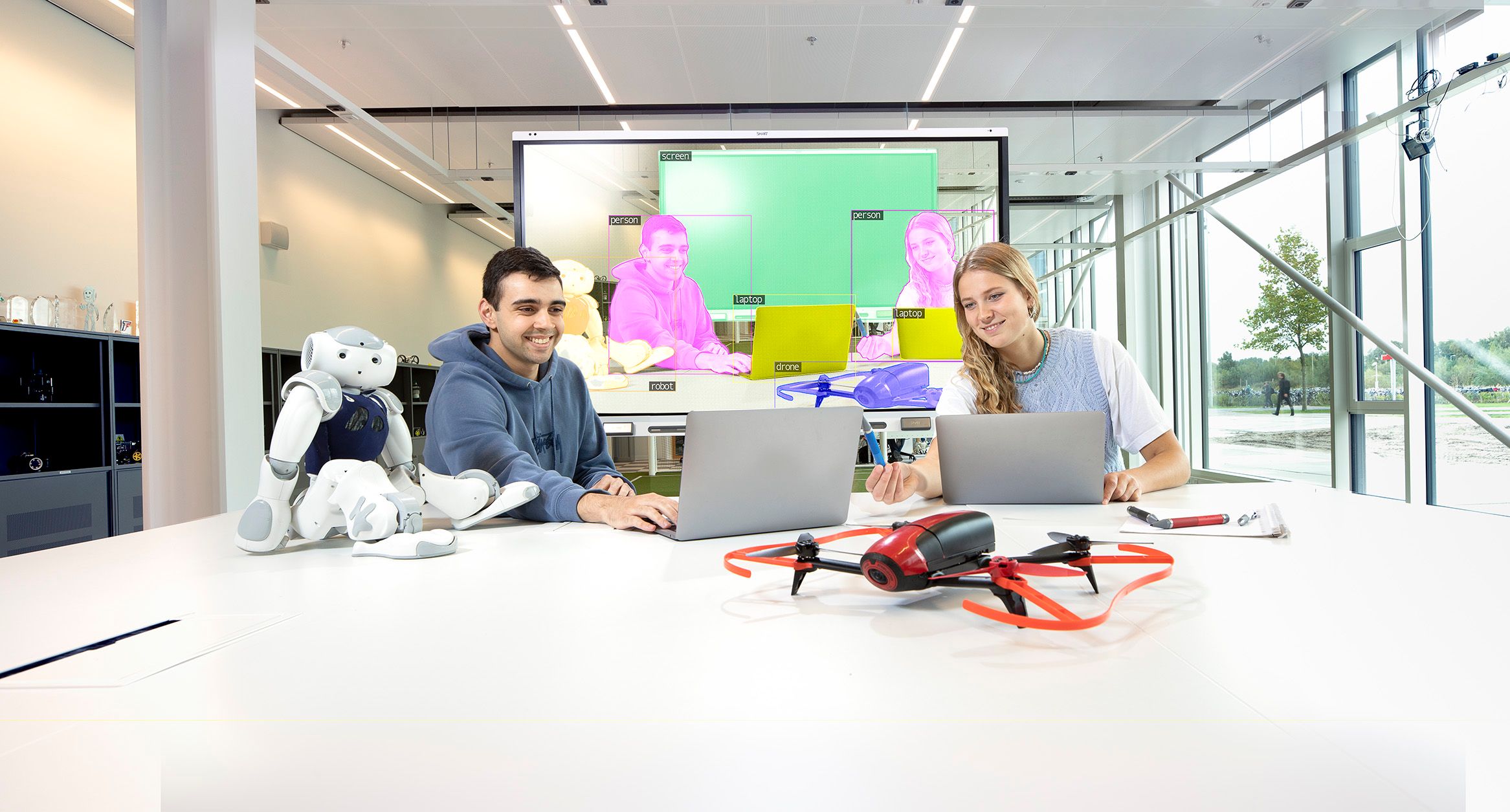
Cognition, Language and Communication

Studieprogramma

Bij CLC leer je vragen stellen én beantwoorden over het menselijk taalvermogen en andere mentale processen die je brein elke dag (al dan niet bewust) uitvoert, oftewel cognitie. Je onderzoekt dus de relatie tussen taal en bijvoorbeeld aandacht, abstract denken, rekenen, het geheugen, logica, overtuigingskracht of het vermogen om te liegen.

Bachelor

Je krijgt naast een basis in de taal- en communicatiewetenschap dus ook te maken met andere vakgebieden, zoals psycho(bio)logie, neurowetenschap, muziekwetenschap, en filosofie. En vanaf dag één leer je je eigen data verzamelen, verwerken, en analyseren.

Na drie jaar draai je je hand niet meer om voor een beetje programmeren, statistiek en diverse onderzoeksmethodes. De richting waarin je je specialiseert heeft veel invloed op je individuele expertises, terwijl je tegelijkertijd met je studiegenoten gericht blijft op het snijvlak van het eigen domein met andere vakgebieden. Alleen met die brede blik kun je hedendaagse complexe vraagstukken te lijf. Zo werkten onze studenten voor onze partners in het publieke en commerciële werkveld aan thema's als eerlijke algoritmes, ethisch omgaan met LLMs, rechtvaardige overheidscommunicatie, meertalige gemeenschappen, taal(vaardigheid) op school en taal en identiteit.

Meike Dries, alumnus CLC
Door Cognition, Language and Communication kan ik nu met een kritische blik naar mijn werk kijken.Meike Dries, alumnus CLCLees het interview

Studieschema

Let op: Dit is het studieschema van het gemeenschappelijke programma van de bachelor Cognition, Language and Communication. De programmaonderdelen van de specialisaties vind je in de Studiegids.


vakkenec
  • Introduction to Linguistics
    Period 1
    6
    You are introduced to the field of linguistics and acquire basic academic skills, such as doing experiments, locating and reading texts and data, and presenting research. These skills are developed further through a group research project.
  • Leading Questions in Cognition, Language and Communication
    Period 1
    6
    You are introduced to the interdisciplinary field of Cognition, Language & Communication. You learn about cognitive mechanisms and acquire theoretical tools to think about cognition from a scientifically-informed perspective. You develop research skills and write a proposal using literature and methods.
  • Designing Research in Cognition, Language and Communication
    Period 2
    6
    You learn to design and conduct research in Cognition, Language and Communication, and deepen your knowledge of methodology and research design. You work on a group research project, tested in a written exam and linked to the Statistics in R course.
  • Verbale communicatie
    Period 2
    6
    Je maakt kennis met theoretische benaderingen van verbale communicatie, zoals retorica, taalhandelingstheorie en argumentatietheorie. Ook leer je hoe deze worden toegepast in onderzoek naar persuasieve teksten.
  • Statistics in R
    Period 3
    6
    You learn statistical analysis and reporting in R, building on earlier skills. You apply statistical methods to your own dataset and write a full research paper, with special focus on the results, discussion and conclusion.
  • Sociale interactie en cognitie
    Period 4
    6
    Je onderzoekt hoe sociale interactie werkt en leert hoe je de structuur ervan systematisch kunt bestuderen. Je maakt kennis met theorieën zoals contextualisering, facework en genretheorie, en met kwalitatieve methoden om cognitieve processen in interactie te analyseren.
  • Human Cognition
    Period 4
    Period 5
    12
    You are introduced to cognitive science, its origins, philosophical foundations, and key questions. You study cognitive modelling and brain research techniques, and develop a well-grounded research proposal in the field under individual supervision.
  • Cognitie en overtuiging
    Period 5
    6
    Je maakt kennis met theorieën over overtuiging binnen de cognitiewetenschap, waaronder rationele en onbewuste beïnvloeding, en de rol van metaforen. Je voert een literatuurstudie uit en presenteert de resultaten in TEDx-format op een interne conferentie.
  • Onderzoeksproject Cognition, Language and Communication 1
    Period 6
    6
    In a small group, you carry out a research project based on a proposal from the Human Cognition course. You report the results in a short paper and give an oral presentation at the propaedeutic-year closing conference.
vakkenec
  • Philosophy of the Humanities (Language and Cognition)
    Period 1
    6
    Je maakt kennis met onderzoeksvragen over taal, communicatie en cognitie via het debat over linguistic relativity. Je leert invloedrijke artikelen begrijpen, verbanden leggen tussen deelgebieden en onderzoeksresultaten interpreteren tegen de achtergrond van menselijke cognitie.
  • Cognition, Language and Communication in Research Papers
    Period 2
    6
    In dit vak maak je kennis met onderzoeksvragen binnen taal, communicatie en cognitie via het debat over language, communication and thought, gestart met de theorie van linguistic relativity. Je leert belangrijke studies begrijpen, verbinden en kritisch bespreken.
  • Onderzoeksproject Cognition, Language and Communication 2
    Period 3
    6
    Je voert in een groepje een klein onderzoek uit op basis van het voorstel uit het vak Cognition, Language and Communication in Research Papers 1. Je rapporteert de resultaten in een paper en via een mondelinge congrespresentatie.
  • Computational Methods
    Period 4
    6
    You study how language properties relate to complexity and learnability. You learn core concepts of Formal Language Theory and read empirical applications. You are introduced to probability theory, random variables, and elementary information theory.
  • Multimodal Perspectives on Cognition, Language & Communication
    Period 5
    6
    You study communication, language and cognition from a multimodal perspective. You compare information encoding across channels, explore simultaneous multimodal communication, and examine how structural or semantic features and cognitive processes relate to the choice and combination of communication channels.
  • Knowledge Application
    Period 6
    6
    Je voert in een groep een project uit voor een externe opdrachtgever. Je leert werken met Design Thinking, maakt een plan van aanpak, presenteert je resultaten en reflecteert op je leerproces en mogelijke loopbaanrichting.
  • Gebonden keuze
    Period 1
    Period 2
    Period 4
    Period 5
    Period 6
    24
vakkenec
  • Vrije keuzeruimte
    Period 1
    Period 2
    Period 3
    Period 4
    Period 5
    30
  • Gebonden keuze
    Period 1
    Period 2
    Period 4
    Period 5
    6
  • Cognitive Modelling
    Period 1
    6
    You learn to construct and test computational models of cognition, language, and communication. The course covers the philosophical background, practical modelling skills, and influential examples, allowing you to evaluate theoretical explanations through model programming and testing.
  • Advanced Statistics
    Period 4
    6
    You expand your data analysis skills with more advanced methods using R and RStudio, building on what you learned in the first two years of the BSc Cognition, Language and Communication.
  • Bacheloronderzoek Cognition, Language and Communication
    Period 5
    Period 6
    12
Verplicht vak
Keuze vak

Gerelateerde opleidingen
Alle UvA-bacheloropleidingen