The Detached Byronic Hero: Starting a Narrative Pilgrimage with Childe Harold
Faculty lecture of the English department
In Childe Harold's Pilgrimage (1812–1818), Byron not only created what came to be known as the "Byronic hero" but also, and equally importantly, a type of narrator that is characterised by a constant re-evaluation of his stance towards his hero and his implied audience. Notably, this type of narration reached its culmination point in Don Juan in Byron's oeuvre, to be followed by verse novels such as Pushkin's Eugene Onegin. In this talk, Julia Bacskai-Atkari will argue that the narrative properties established in Childe Harold can also be detected in other narrative works such as Mazeppa, and also in dramatic works such as Cain.
Event details from: The Detached Byronic Hero: Starting a Narrative Pilgrimage with Childe Harold
- Date
- 23 September 2026
- Time
- 17:00
- Room
- 0.05
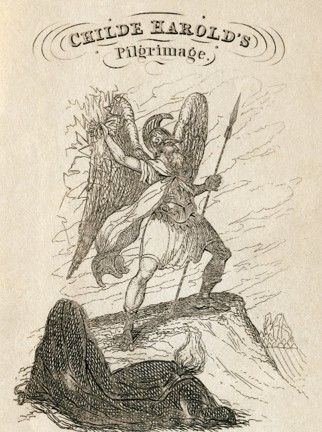
While formally a narrative, one of the most striking properties of Childe Harold is precisely the lack of a narrative, in terms of a story: little background is provided regarding the causes behind Harold's "spleen" and his pilgrimage. For the rest of the journey, Harold becomes more of an anchor providing the point of view than a hero. The narrator takes over at the expense of the hero, who primarily serves as a vehicle (or even as a pretence) for the narrator to express his own thoughts – at least as he deems necessary, since he appears to have lost Harold towards the end of the text.
This strategy is paired up with yet another Byronic property, which is the narrator's changing attitude towards his hero. Initially, the two seem to be almost inseparable (resulting in contemporary readings conflating Childe Harold with Byron himself), yet later the narrator clearly detaches himself from his hero, not the least by neglecting him and also by establishing a superior stance (which in later works typically results in a mocking tone). Importantly, this textual playfulness also affects his attitude towards the assumed readers, who may or may not be invited to share his perspective.
Everyone is welcome to attend. You don't have to sign up in advance.
Speaker
Julia Bacskai-Atkari completed her doctoral studies in literature at the University of Hamburg in 2018. Before that, she earned a doctoral degree in linguistics at the University of Potsdam. Following academic positions at the University of Potsdam and the University of Konstanz, she is currently assistant professor for Language Contact: (English) Linguistics at the University of Amsterdam and a Privatdozentin at the University of Potsdam. Her research focus in literary studies is on the verse novel, especially on the narrative properties of the genre, as well as on Byron's oeuvre.