Feelee app: truly helping young people through an app on their phones
The mental health of young people is rapidly deteriorating. At the same time, youth care is under pressure and waiting lists are growing. To support young people, UvA scientists have developed the mobile app Feelee. This app offers young people insight into their habits and emotions. Levi van Dam - UvA scientist, educator, and social entrepreneur - explains what the app entails, why it is important and what the plans are for the future.
'We want to encourage young people to use their phones as a source for social good.'Levi van Dam
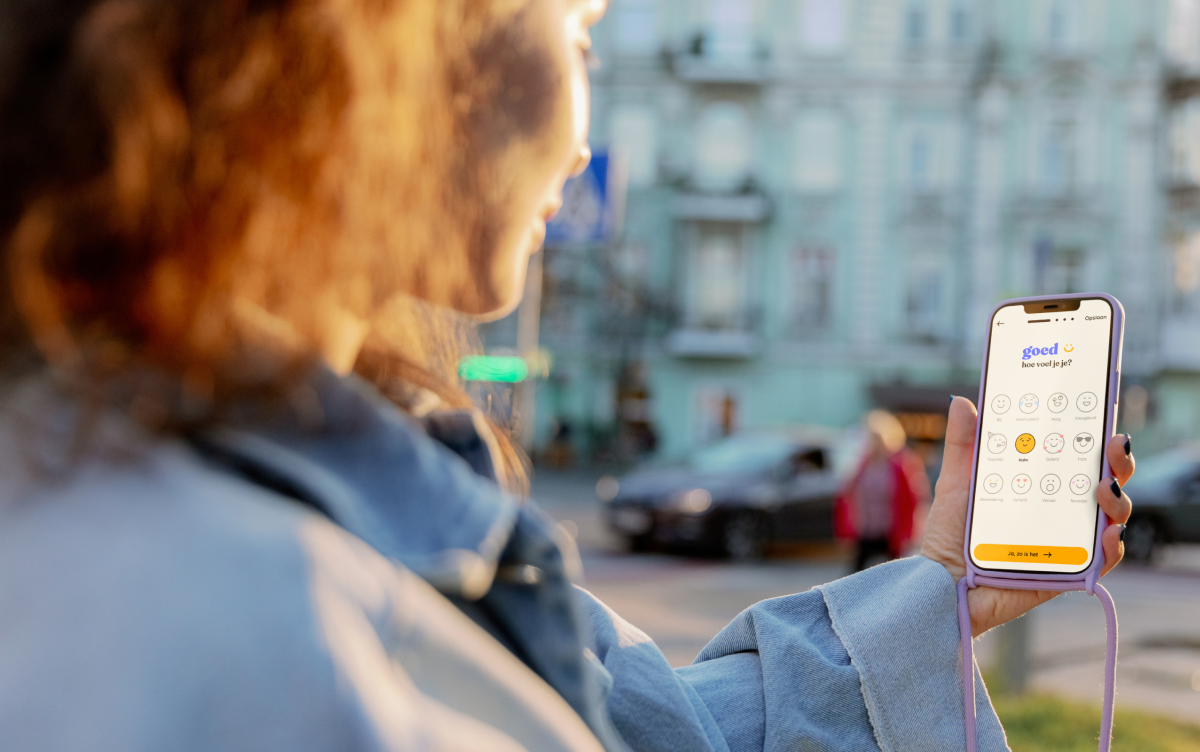
What is Feelee and how does it work?
'Feelee is an app for young people who want to learn more about their emotions. Three times a day in this app, they can indicate how they feel by choosing an emoji. (Emojis are small digital images that allow you to convey an emotion directly, without using text.) The app connects that information to passive data stored in the phone, such as the number of steps you take per day and the number of hours you sleep per night. You can think of it as a kind of journal.'
Why is this app needed?
'For a few years now, many young people have been experiencing quite a lot of mental pressure. As a result of corona, but also through other causes. We see that young people are often busy on their phones. Sometimes for healthy purposes, but mostly they spend hours staring aimlessly them, which doesn't make anyone happy. We want to encourage young people to use their phones as a source for social good.'
How did you come up with the idea to create the app?
'When I spent a month in Boston while writing my dissertation, I met Professor Alex Pentland (Social Physics, Massachusetts Institute of Technology). With an app, he was able to predict when someone would get the flu, based on passive data stored in a phone. Data on walking distances, day and night rhythms and the extent of phone use are also measured. I wondered: can we predict, not only someone's physical state, but also their mental state with this kind of data? I took his research app to The Netherlands and set out to investigate this, together with Professor Arne Popma (Amsterdam UMC and Levvel).'
How did this idea subsequently develop?
'Over the past four years, we ran several pilots with the app. For instance, we started with a group of 30 young people who were in treatment for psychological problems at Levvel, a youth care organisation in Amsterdam. Then we switched to a group of five hundred young people. Above all, we wanted to learn. What does the target group think of such an app? Do they want to share their data with us?'
What was the outcome?
'Because the psychologists of these young people received additional information about them through the app, they gained more insight into the habits of this group. And as a result, they were able to discuss different topics in their conversations. For example, one of the therapists discovered that her patient - who suffered from aggression - was reliving a trauma at night, because the app indicated that he woke up several times. By treating that trauma first, they could then better assess whether treatment for his aggression regulation was still needed.'
Could you also do something with the data?
‘We did see some patterns emerging, but we also discovered that we couldn't draw any conclusions from the data. The available dataset turned out to be too small and contained "gaps". This made it impossible to prove our findings scientifically. We therefore started developing our own app a year and a half ago, together with creative design agency Greenberry. This app can collect the data we need and looks attractive. The app has now been downloaded by some 2,500 young people. That's more data than we have ever had.'
What are your plans now?
'So far, we have only developed an app in which young people can journal. This has caused many young people to quickly drop out. We therefore want to offer more. Think of scientifically substantiated advice, suggestions, with which we can really help young people. That information is ready. Now, we just do not know who needs which advice. For that, we need to make the app more intelligent. With artificial intelligence (AI), we want to teach Feelee to give the right advice to the right people, at the right time'.
What do you still need to accomplish this?
'We need to invest in marketing, technology, and manpower. For a wider reach and thus sufficient data, we need more users. And for technological further development, we need the right technology and people.'
How do you see the future of Feelee?
'We want Feelee to be able to contribute to the prevention of mental health problems in order to relieve the burden on youth care. But we are also looking at whether we can use Feelee more broadly. We are having conversations with employers. And we are looking into whether we can offer the app to employees on behalf of a supermarket chain, in order for the supermarket to gain more insight into the mental well-being of its staff. That way, we can use science to contribute to solutions for social problems.'
This year, AUF's Annual Fund draws special attention to young people. 'With the Feelee app, we can improve help for young people with mental problems. Contribute to the further development of this app, so that Levi van Dam and Arne Popma can respond to this social problem with science.