Plant DNA can assist in forensic investigation following a chemical attack
Toxic chemicals have been used as weapons since ancient times – from poisoned arrows to contaminating water supplies or adding snake venom to food. Recent chemical attacks in Syria and Ukraine, as well as the poisonings of Sergei Skripal and Alexei Navalny have brought the issue of use of chemical weapons back into focus. Forensic investigations following a chemical attack are often highly challenging since chemical warfare agents are highly reactive and rapidly degrade in the environment or metabolise in the human body. Therefore, new methods for identifying and tracing the chemicals used are needed. Forensic analytical chemist Mirjam de Bruin-Hoegée examined this issue during her PhD. She will defend her thesis on the subject at the UvA on 12 June.

The aftermath of a chemical attack will often be a chaotic and confusing scene. De Bruin-Hoegée: ‘The first question in the investigation is “What kind of chemical is it?”, this can be important for the safety of first responders and to know which countermeasures should be used. The next is “Who did it?”. Chemical profiling can play an important role in providing answers to both.’
Chemicals are very rarely unadulterated, they almost always contain impurities which can provide investigators with information about, for example, where they were produced. The goal of De Bruin-Hoegée’s research was to expand the possibilities for extracting such information, given the frequently challenging nature of the aftermath of a chemical attack.
Plants as evidence
After a chemical attack in a conflict zone, forensic investigators may face difficulties in reaching the crime scene directly due to safety and security considerations. This means that they will be unable to measure intact chemical warfare agents, which in turn obstructs a thorough crime scene investigation and an accurate reconstruction of events.
To tackle this issue, we came up with a new method of using plants as an alternative source of evidence. Plants are often abundantly present at incident sites and their use under such circumstances had previously been studied, but only in terms of intact chemicals on the surface of the plant. We went much further, though, and looked inside the plants to where the chemicals had attached themselves to their DNA and proteins. We showed that even three months after actual exposure, traces of chemical warfare agents can still be detected inside plants.
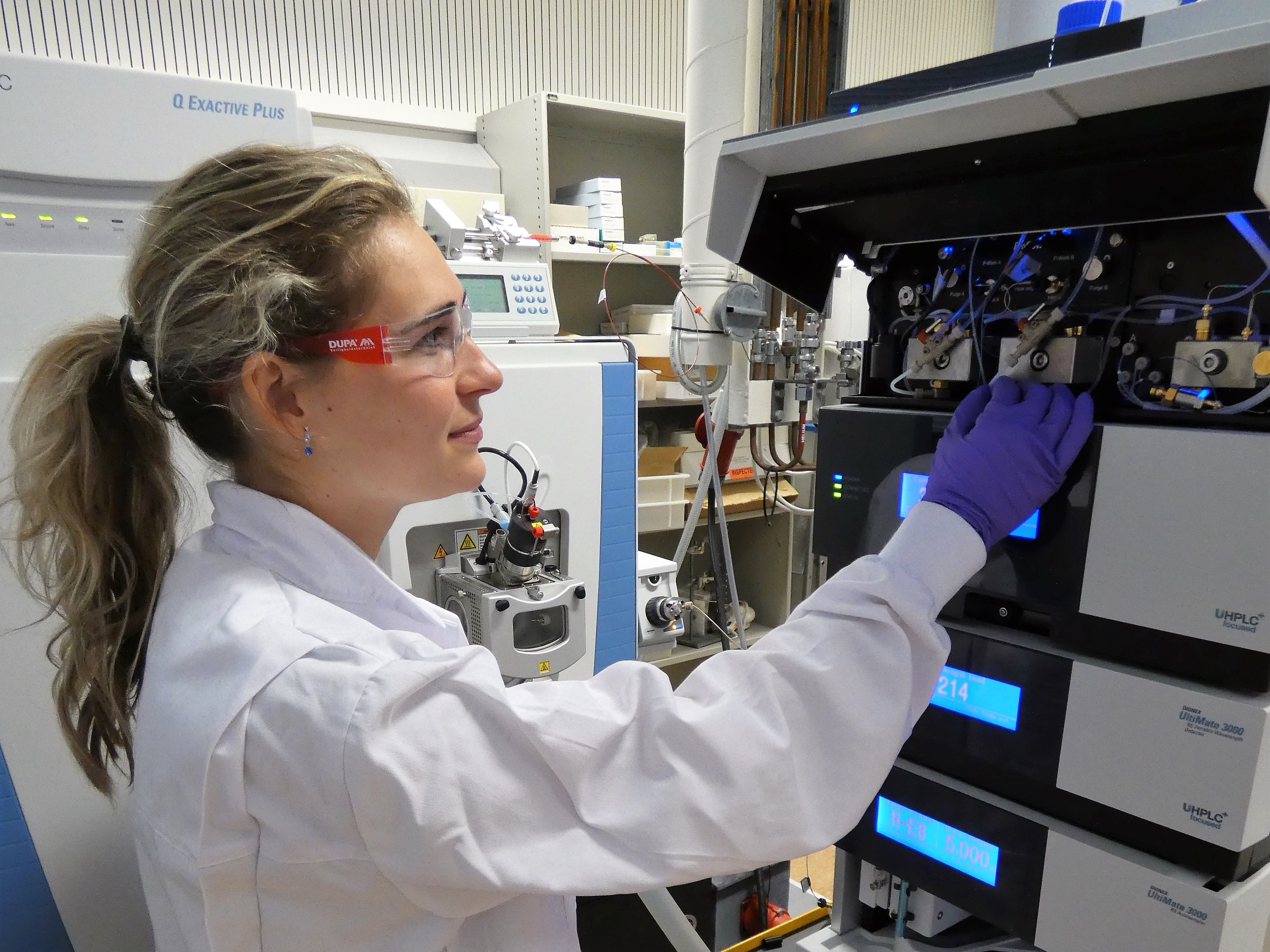
We showed that even three months after actual exposure, traces of chemical warfare agents can still be detected inside plants.Mirjam de Bruin-Hoegée
Blood and plastics
De Bruin-Hoegée also delved deeper into other areas to uncover where analysis and identification could be improved. She showed that dried human blood could be used for verification of exposure to chemical agents much longer after an attack than was previously thought. ‘We also looked at plastics – in an improvised explosive device you often have PVC tubing, electrical wires, tape and so on, so we are developing ways in which we can pinpoint, for example, the brand of tape that was used purely by chemical profile.’
De Bruin-Hoegée is hopeful that the discoveries she has made can soon be implemented in the field. The updated version of the VERIFIN Handbook - Verification of Chemical Warfare Agents – which is used by investigators from the Hague-based Organisation for the Prohibition of Chemical Weapons – now includes elements of her research.
‘Much of this work has only been tested in the lab, so it will be important to see how it works in the field. We also need to study a wider variety of chemicals and keep advancing these techniques, so that chemical profiling strategies become widely recognised as evidence with a high forensic value in courts of law.’
Defence details
Mirjam de Bruin-Hoegée: Revealing the Origin of Chemical Weapons. Supervisors are Prof. A.C. van Asten and Prof. ir. P.J. Schoenmakers. Co-supervisors are Dr D. Noort and Dr M.J. van der Schans.
Time and location
De Bruin-Hoegée’s PhD defence ceremony will take place on Tuesday, 12 June, at 14.00, in the Aula of the UvA.