PDI-SSH grants structurally granted to Honing and Roelofsen
The 2021 grants of Platform Digitale Infrastructuur (Social Sciences & Humanities) awarded to Henkjan Honing and Floris Roelofsen have been turned into structural grants.
Digital Infractructure SSH
There has been a strong desire in the fields of social sciences and humanities (SSH) to assign part of the resources intended for the SSH Sector Plan of the Ministry of Education, Culture and Science (OCW) to a domain wide digital SSH plan to support accessible, high-quality digital infrastructure facilities. Digital infrastructure plays an increasingly important role and in many cases is the foundation of leading research into the social and scientific issues of the digital society. This not only concerns infrastructure for collecting data, but also infrastructure for storing, publishing, analysing and linking data. In addition, these infrastructures require professional support, for example from data managers and infrastructure specialists. Researchers also have a growing need for digital support and expertise.

Project: A flexible and sustainable infrastructure for MUSic-related Citizen Science Listening Experiments [MUSCLE]
Applicant: Dr Henkjan Honing (ILLC)
Data science has had an enormous impact on music research in the last few years, with several international labs basing their scientific insights on large amounts of empirical data. The UvA has contributed to this research by showing that engaging games can serve as a powerful method to attract hundreds of thousands reliable participant responses. This unprecedented scale is necessary to characterize musical behavior properly, in particular how it varies among individuals and across societies. In addition to the technical demands of game-like listening experiments, both music and citizen science require infrastructural support that is currently not addressed by any of the existing digital infrastructures (such as CLARIAH). Hence, the aim of the current proposal is to fill this gap by developing a flexible and sustainable infrastructure for music-related citizen science listening experiments, for domains that have special needs with regard to high-quality, platform-independent audio presentation, processing and timing of responses (e.g., music information retrieval, music cognition, computational musicology, phonetics and speech research). The software developed in the project will be made available as an open-source toolkit that both Dutch and international universities can choose to adapt on their own servers.
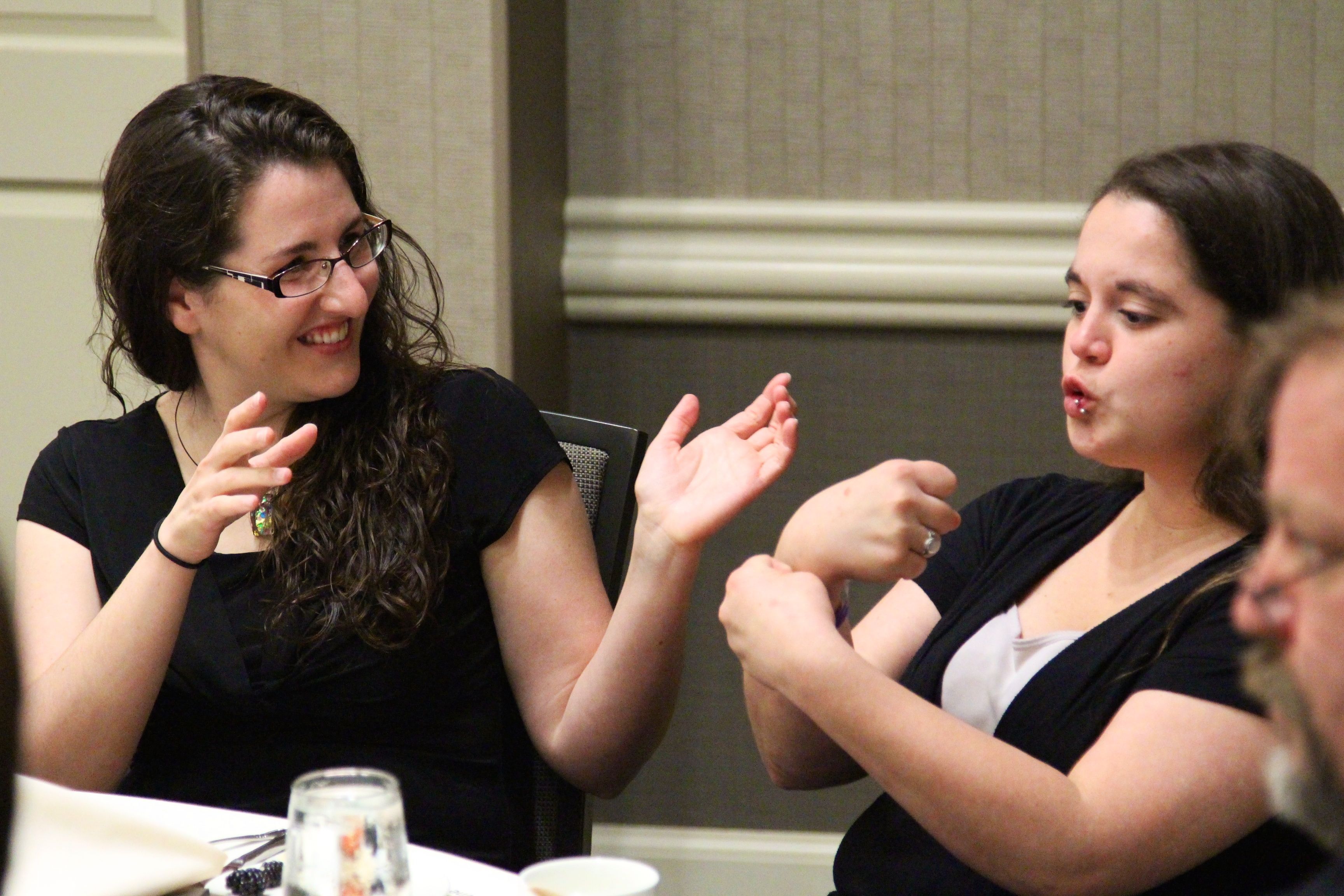
Project: Infrastructure for SSH research on Sign Language of the Netherlands
Applicants: Dr Onno Crasborn (RU) and Prof. Floris Roelofsen (ILLC)
This project will make significant contributions to the digital infrastructure that is needed for SSH researchers to investigate the sign language of the Netherlands (Nederlandse Gebarentaal, NGT), which is lawfully recognised as of 1 July 2021 as one of the country’s official languages but not yet covered by infrastructure projects like CLARIAH. One of the key problems in studying sign languages is that they lack a writing system. Primary data are in video format and currently need to be transcribed and annotated manually. Creating consistent annotations across datasets requires connecting annotation software (ELAN) to an NGT lexicon that does justice to the morphological, semantic, and phonetic characteristics of the language—words in NGT and Dutch do not match in structure or meaning, making it difficult to build on lexical resources for Dutch. The project therefore focuses on (i) a digital NGT lexicon with semantic and phonetic information, (ii) NGT corpora of adult language use as well as interactions between adults and children, and (iii) software for machine-supported annotation, using novel AI technologies. It connects these sign language resources to existing infrastructures within CLARIAH, enriching the CLARIN-K Centre for Atypical Communication Expertise (ACE) to maintain and bundle tools and resources for NGT.