Where do music and musicality come from?
Professor of Music Cognition Henkjan Honing will deliver his valedictory lecture on 4 December
What are the origins of music? For a long time, this was difficult to investigate, because music and the musical brain leave no fossil traces. But over the past twenty years, new ways of approaching this question have emerged. In his valedictory lecture, professor of Music Cognition Henkjan Honing discusses how researchers are becoming increasingly able to study the origins of our musical abilities.


Today, research into music and musicality brings together scientists from many different disciplines, from musicology and anthropology to neuroscience, genetics and evolutionary biology. This has also led to a shift in focus from music as a cultural and social phenomenon to musicality, Honing explains.
‘Musicality is the set of cognitive and biological capacities that enable us to perceive, make and appreciate music. This perspective opens up new possibilities for exploring the origins of music.’
Beat perception in newborn babies
A large number of studies now show that almost everyone has musical abilities, the professor explains. ‘Even without being a musician or composer, we can recognize and appreciate music.’ And those abilities develop early on. After birth, for example, babies can already recognize melodies they heard in the womb.
Honing and his colleagues studied, among other things, beat perception: hearing a regular pulse in a varying rhythm. ‘This ability helps us coordinate our movements when we dance or make music together, and is considered a fundamental building block of musicality. In our research, we have shown that beat perception is already active in newborn babies.’
But if people share musical abilities, why does music sound so different around the world? ‘Music varies greatly across time and place, yet certain musical structures recur remarkably often,’ says the professor. ‘This suggests that the diversity of music builds on shared human abilities.’
What animals teach us about musicality
To understand how far back shared musical abilities go, Honing also looks at species other than humans. ‘Humans are a musical species, so why should we be the only one? Similarities and differences between closely related species give us clues to reconstruct which abilities may already have been present in common ancestors.’
Humans are a musical species, and why should they be the only one?
Throughout his impressive scientific career, Honing has studied musicality in species including chimpanzees and zebra finches. Some building blocks of musicality, such as perceiving differences in sound and recognizing melodic contours, do indeed appear to exist in species other than humans. This may suggest that both music and language build on older, shared abilities that we now also regard as building blocks of musicality, the professor argues.
A mosaic of abilities
‘By mapping musical abilities and comparing them across cultures and species, we can investigate their evolutionary origins in a targeted way,’ Honing concludes. ‘Little by little, a picture emerges of musicality as a mosaic of abilities with different evolutionary histories: some ancient and widely shared, others arising independently or developing further in our own species. Many details are still missing, but the outlines are becoming increasingly clear.’

TuneTwins: Test your musical memory!
Following the success of Hooked on Music, the Music Cognition Group at the University of Amsterdam presents a new game: TuneTwins. Inspired by the classic Memory game, TuneTwins invites you to match pairs of musical frag...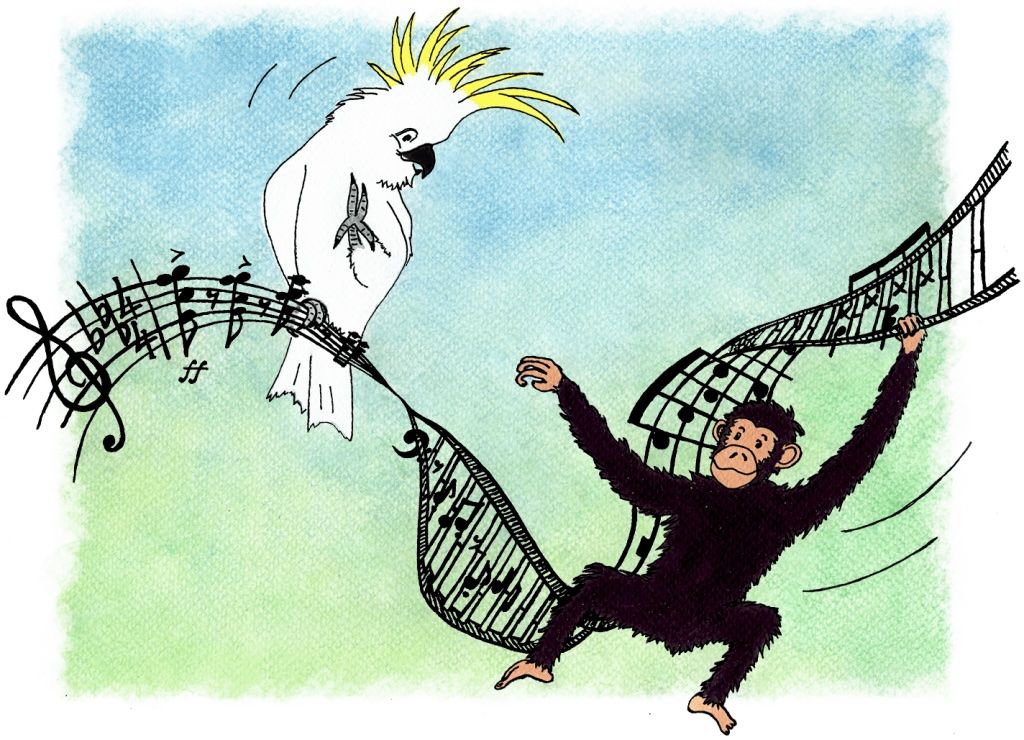
From speculation to science: Humans are born musical
Humans are fundamentally “musical animals” – and our capacity for music is rooted in biology, not just culture. This is the conclusion of new work by UvA professor of Music Cognition Henkjan Honing. In ‘The Biology of Mu...
Uitvogelen. Over de oorsprong van muziek.
In zijn afscheidscollege laat Henkjan Honing zien hoe het onderscheid tussen muziek en muzikaliteit nieuwe mogelijkheden biedt om de oorsprong van ons muzikale vermogen wetenschappelijk te onderzoeken.- Bachelor's
Muziekwetenschap
Bij Muziekwetenschap verdiep je je in muziek vanuit historisch, cultureel en cognitief perspectief. Daarnaast leer je op een systematische manier vragen stellen over het belang van muziek in ons leven.