The architecture of societal transitions
How systems thinking paves the way for lasting behavioural change
Whether it is the stubborn mountain of plastic waste, the obesity epidemic, or the climate crisis: we so often try to solve complex societal problems with isolated interventions and individual behavioural nudges. To no avail. According to Jan Willem Bolderdijk, Professor of Sustainability and Marketing at the Amsterdam Business School and director of the research centre MIST, the crux of the matter lies not in a lack of goodwill on the part of the individual consumer, but in the design of the environment. 'We invest enormous energy in trying to persuade individuals, while those individuals are often trapped in a system that simply does not reward sustainable behaviour.'

During a recent keynote to a packed room of professionals, Jan Willem Bolderdijk asked his audience to do something rather unusual: to stand up and dance. It began awkwardly. A small group of 'innovators' took the first step. Within seconds, the entire room was moving. 'What you just felt in your own body is a social tipping point,' Bolderdijk explained to his laughing audience. 'It shows that change does not happen gradually. It happens in jolts and leaps.'
This image lies at the heart of Bolderdijk's work. In a world that is desperately seeking solutions to complex, so-called wicked problems — issues such as plastic pollution, the biodiversity crisis, and the energy transition — he and fellow researchers at the MIST centre (Marketing Insights for Societal Transitions) offer a compass. The direction they point to? We must stop viewing society as a predictable clockwork mechanism and start treating it as the complex, unruly system it truly is.
The illusion of linear progress
Administrators and policymakers frequently fall into the same trap: a belief in linear change. In that view, behavioural change works like adjusting a clock: you turn the hand a little, and the time shifts accordingly. 'A subsidy is introduced, or an awareness campaign is launched, and a proportional result is expected,' says Bolderdijk. 'But in reality, often nothing happens for a long time. Until, suddenly, an enormous shift occurs that nobody saw coming.'
Bolderdijk bases his thinking in part on the work of Donella Meadows, author of the classic Thinking in Systems. It was her work, alongside that of his colleagues at POLDER, that inspired him to stop viewing consumer behaviour as an isolated variable and instead see it as one element within a larger network. Behavioural change is the tip of the iceberg: beneath the surface lies a complex system of interlocking processes. Bolderdijk compares that system to a heavy dining chair you are trying to topple. You can push against it as hard as you like, but the chair stays on 4 legs. Only when the centre of gravity crosses a critical threshold does the chair fall. That moment is the tipping point. The work of MIST focuses, amongst other things, on the question of which processes maintain the status quo, and where the so-called leverage points are located within the system — places where a well-aimed push can ripple outwards and trigger change across the rest of the system. In this way, MIST aims not only to explain the transition towards a sustainable society, but to actively accelerate it.
The landscape of our habits
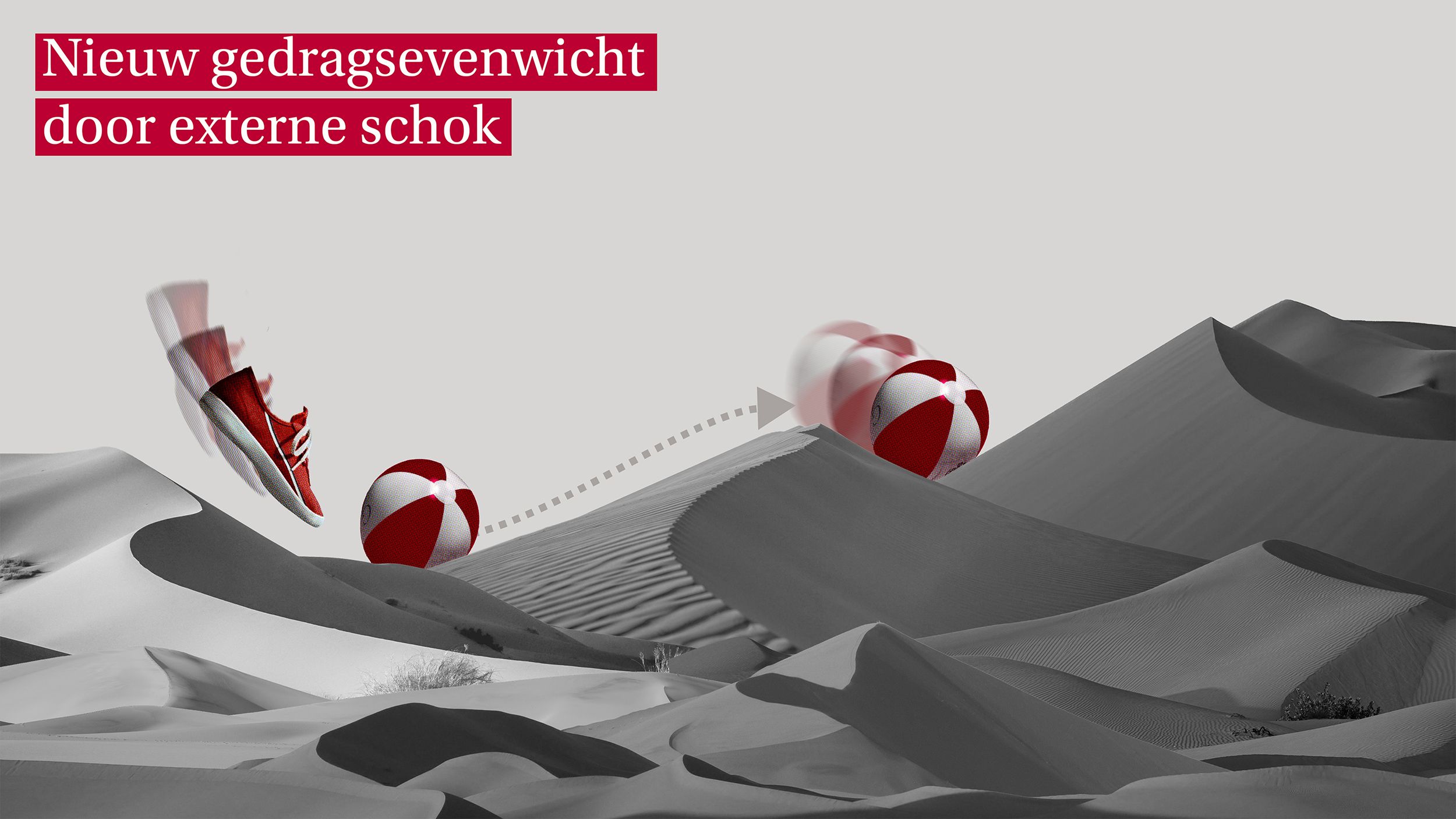
To understand why we so often find ourselves locked into socially undesirable behaviour, Bolderdijk draws on concepts from complex dynamic systems, the attractor landscape being one of them. Imagine a landscape of deep valleys and high hills. Our current habits — eating meat every day, or smoking — can be thought of as a ball sitting in one of those deep valleys. That valley is a 'stable equilibrium'. It is deep because everything in our environment makes that unsustainable behaviour easy and therefore self-perpetuating: it is cheap, socially accepted, and available everywhere.
According to Bolderdijk, there are 2 ways to get a ball (our behaviour) out of such a valley and move it towards a different equilibrium:
- The external shock (noise-induced tipping)
Cast your mind back to the Covid-19 pandemic: overnight, we stopped shaking hands. The system underwent an enormous external shock, sending the ball tumbling into a new valley. 'This is effective when there is immediate urgency,' says Bolderdijk. 'But the landscape itself has not changed. Once the pressure lifts, there is a strong chance the ball will roll back into the old, deep valley. It is change driven by force, not by design.'
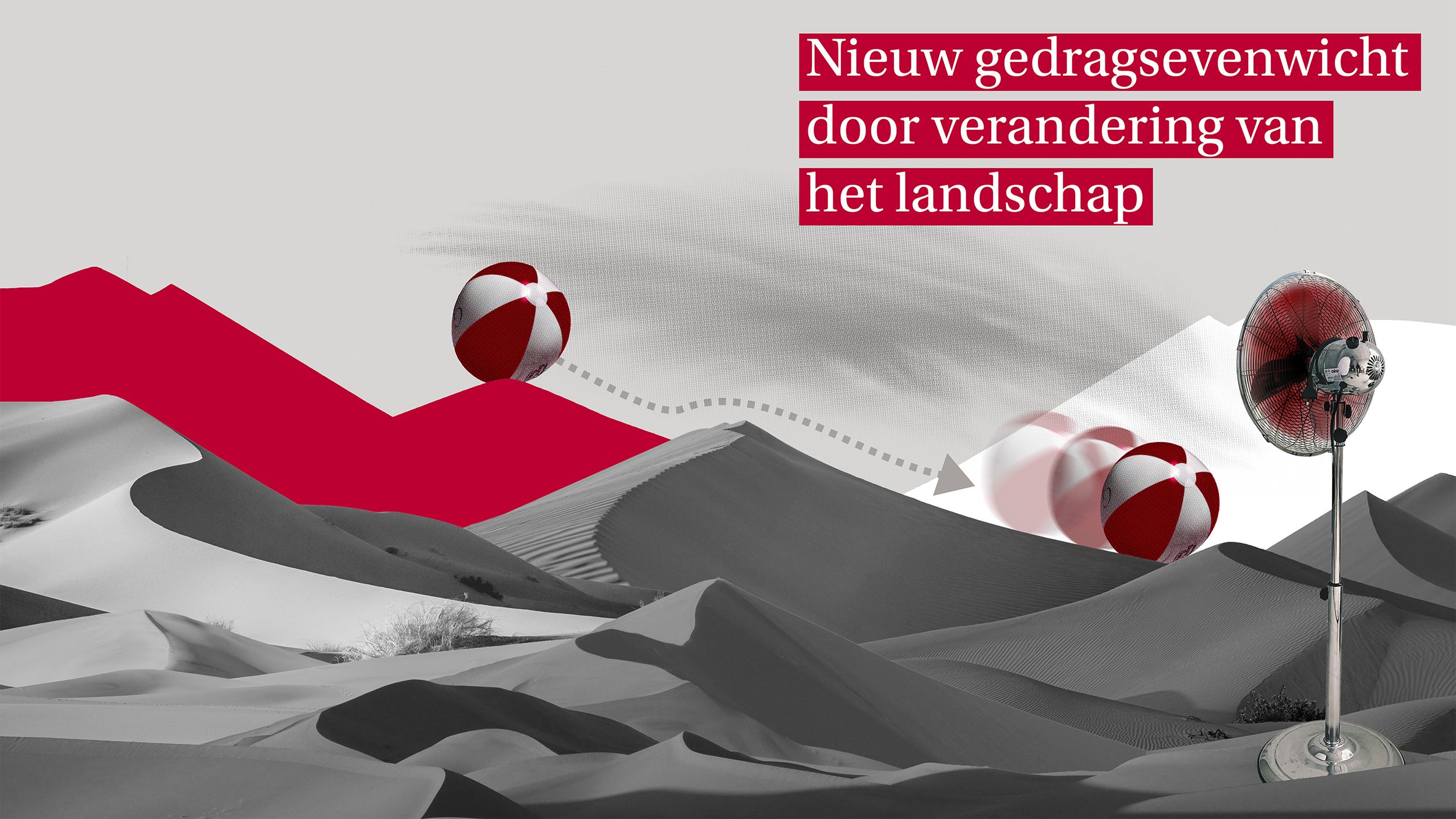
2. Reshaping the landscape (bifurcation-induced tipping)
This is where the true power of systems thinking lies. Rather than pushing against the ball, you begin to reshape the landscape itself. You make the old valley shallower — by making meat more expensive, for instance, or by banning plastic — and you dig a new, attractive valley elsewhere, by making sustainable alternatives the default option. 'You ensure that the system almost tips towards the new situation of its own accord,' Bolderdijk explains. 'The ball no longer rolls back, because the new situation has become the new stable equilibrium.'
The anatomy of a tipping point: the 3 feedback loops in a behavioural system
An good example of this 'redesigning' of the behavioural landscape is an experiment carried out during the SAIL Amsterdam festival. The organisers asked MIST how they could encourage visitors to eat more plant-based food. The researchers began with a systems analysis: what forces and factors sustain the current behaviour — eating meat? They mapped 3 feedback loops: a psychological loop (a negative perception of plant-based food), a social loop (people choose what others choose), and a structural loop (caterers offer few plant-based options, out of fear of lost revenue). Each loop simultaneously represents an entry point for a leverage point: a localised place within the system where a targeted intervention can produce an effect across the rest of it.
During the experiment, the 'SAIL croquette' was introduced: visitors bought a vegetarian croquette, but were only told afterwards that it had been meat-free. Those visitors subsequently chose plant-based options significantly more often than visitors who had not had this experience. How does that work? The positive eating experience reduced the psychological resistance to plant-based food: if you have unknowingly enjoyed a veggie croquette, you have less reason to doubt the taste of other meat alternatives. This small shift also moved the social norm: as more people (consciously or not) made plant-based choices, that choice became more visible and more common. And as demand for plant-based food grew, caterers saw a reason to expand their offering. In this way, psychology, the social environment, and the market reinforce one another in a virtuous cycle. The intervention gave the system a nudge at precisely the right leverage points, with the desired behavioural change as the result.
Interventions that actually work
Although the SAIL example illustrates how systems can be positively influenced, Bolderdijk warns that poorly considered interventions can be ineffective, or even counterproductive. A striking example is a second-hand clothing platform. At first glance, this appears to be a sustainable initiative. But systems thinking reveals a different picture: consumers sometimes buy more new clothing precisely because they know they can easily resell it. This so-called 'rebound effect' actually keeps the system of overconsumption intact.
This is where MIST's expertise becomes valuable. Through systems thinking, these complex behavioural systems can be mapped in a rigorous and scientific manner. 'We demonstrate that behaviour is not a ‘black box’ beyond your control. Using system mapping — one of the methods for applying systems thinking — we make the processes behind behavioural patterns more transparent,' says Bolderdijk. This prevents organisations from investing considerable time and money in campaigns that prove ineffective because they fail to intervene at the right leverage points.
Systems thinking in practice
The societal relevance of this work extends far beyond the walls of the university. MIST is actively committed to bringing knowledge out into the world, through lectures for organisations including ASN Bank, the Social and Economic Council of the Netherlands (SER), the Ministry of Infrastructure and Water Management, the Netherlands Authority for the Financial Markets (AFM), and Rabobank — as well as through structural partnerships. One example is the collaboration with the Government Information Service (Dienst Publieke Communicatie, DPC), the public body responsible for sharing knowledge about effective communication campaigns. In this partnership, MIST deliberately does not assume the role of consultant. Rather than delivering ready-made analyses, the researchers teach the behavioural scientists within the DPC to view the world through a systems lens themselves, and to master the associated methodological tools. The aim is lasting impact: an organisation capable of applying systems thinking independently, rather than remaining reliant on external expertise.
Researcher Bas Châtel joined the DPC as an impact postdoctoral researcher to make that systems perspective practically applicable within policy and communication processes. Where behaviour has traditionally been understood primarily as the outcome of individual choices, a systems lens shifts the focus to the broader context: the social norms, institutional conditions, and infrastructure that together shape behaviour. Behavioural change is thus approached not only from the perspective of the individual, but from that of the broader system in which that behaviour arises and is sustained. Through working sessions with communication professionals, Châtel clarifies when communication is a promising point of intervention, when other policy instruments are more effective, and where interventions may reinforce one another or inadvertently produce unintended consequences.
The systems lens also helps in the debate on fossil fuel advertising. Bolderdijk and colleagues are investigating the effects of an advertising ban, for example on social norms surrounding air travel. Their insights and an expert opinion underpinned the effectiveness of The Hague’s ban in the interim relief proceedings brought by the travel industry. The court ruled in favour of the municipality, and the ban remains in force. Utrecht, Zwolle and Leiden subsequently followed suit with their own bans.
Courageous leadership
'Leaders need certainty,' Bolderdijk acknowledges. Yet the most challenging aspect of systems thinking is the factor of time. Before a system tips, there is often a period of pre-critical stress. The system becomes unstable, friction builds, but the larger shift is not yet visible. 'In a linear world, we would pull the plug at that point, because we see no immediate results,' Bolderdijk cautions. 'But this may be precisely the phase in which the chair is on the verge of toppling.'
The transition to a sustainable world therefore calls for leaders with a long-term horizon, and a willingness to let go of the search for a quick fix or a silver bullet. What systems thinking reveals is that behavioural change is rarely the result of a single intervention, but of a well-chosen and well-timed combination of interventions that first destabilise the system and then make a tipping point possible. The work of MIST provides a grip on transitions. 'We have the knowledge to shift the valleys in our landscape,' Bolderdijk concludes on an optimistic note. 'If we change the architecture of our behaviour, anything becomes possible.'
Want to know more?
The Impact Centre involved is: Marketing Insights for Societal Transitions (MIST)