'The most interesting routes are often found off the beaten track'
Amsterdam Law School
10 juni 2026
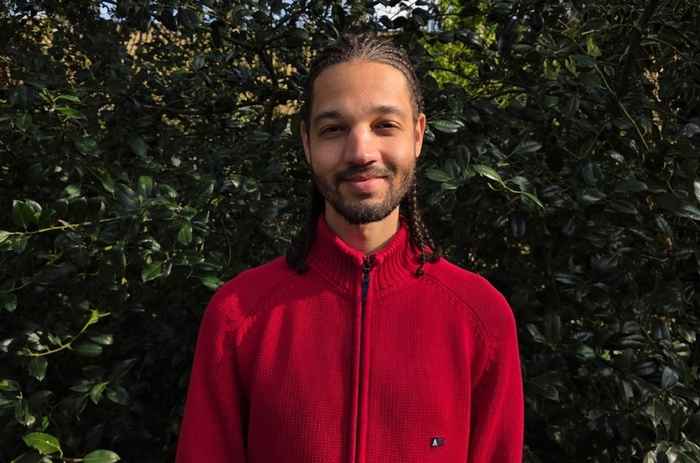
Leroy Niekoop is a project leader in the programme against discrimination and racism at the Ministry of Education, Culture and Science (OCW). Since then, his career has unfolded at the intersection of law, human rights and social impact. 'Seek out practical experience and dare to look beyond the obvious, because the most interesting routes are often found off the beaten track.'
From an early age, Leroy knew he wanted to make a difference in the world around him. 'From my very first work experience placement in secondary school, I felt that I wanted to contribute. I shadowed staff at an anti-discrimination office, and that stayed with me.' His route began with a degree in Social Legal Services at a university of applied sciences, but Leroy soon realised that his main interest lay in law. 'In the first year I discovered that I missed academic depth.' When he switched to the Bachelor’s in Law at VU Amsterdam, everything fell into place – especially when he was introduced to international law. 'That international perspective really appealed to me: the idea that you can contribute to a better world through law.'
Deliberately broadening his perspective during his studies
After completing his Master’s in Public International Law at the UvA, Leroy deliberately chose a second Master’s: Middle Eastern Studies. 'I wanted to push myself to look at things differently. That programme was much broader: history, geopolitics, but also law. It taught me to analyse texts and questions in a different way.' This broader perspective built on a previous minor in Middle Eastern Studies and courses such as Islamic Family Law. 'It gave context to issues I had previously mainly viewed from a legal angle.'
First steps on the labour market
For Leroy, the transition from studying to working did not feel straightforward. 'You spend years studying and then suddenly it’s over. That took some figuring out.' Through an internship at Justice and Peace in The Hague, he came into contact with human rights defenders from all over the world. 'Journalists, lawyers, environmental activists – many of them work under enormous pressure. Through the Shelter City programme, they could come to the Netherlands for a while to catch their breath and build new tools and networks.'
That experience made a deep impression and led to his next step: a position at Lawyers for Lawyers, a small international organisation that supports lawyers at risk. 'There I really saw how law works in practice. Sometimes we supported individual lawyers who were detained or prosecuted. I went to Turkey, for example, to observe court cases against lawyers. Our presence alone sends a signal: the world is watching.'
Working on human rights in practice
Alongside that individual support, Leroy also worked at the international level. 'We wrote reports, drafted statements for the UN and had speaking time at the Human Rights Council. You are constantly asking: what is happening in this specific country, which rights are being violated, and what needs to change to ensure a free and independent practice of the legal profession?' At the same time, Leroy worked closely with Dutch volunteer lawyers. 'That was perhaps what I appreciated most: people who set aside time alongside their regular work to support colleagues around the world.'
Even so, something began to shift. 'The work was very valuable, but it can sometimes be difficult to see the impact at a larger scale. You do important work to support individuals, but structural change takes time.' That realisation brought him back to an earlier thought: 'There are still so many issues around discrimination and racism here in the Netherlands as well.'
Moving into policy at OCW
His search came together when Leroy came across a vacancy at the Ministry of OCW. 'The Programme against Discrimination and Racism had just been set up, partly in response to the Black Lives Matter protests. That appealed to me: a new environment where something was really being built.' He was also curious about “the other side”. 'In my previous work I had a lot of contact with policymakers. I wanted to know: what actually happens with all those signals once they reach a ministry?'
In his current role, Leroy focuses on driving policy, advising the organisation and setting up projects. 'We also try to set a standard within the ministry: how do we talk about these topics, and what do we do with them?” One of the highlights for him was his involvement in the Slavery Past Commemoration Year. “That was an opportunity to give more attention to something that has long been underexposed, and to highlight the link between that past and its impact on the present.'
What appeals to him in his work is the combination of content and impact. 'You work on concrete actions, build networks and bring external expertise into the ministry. That helps to break through the "The Hague bubble".' At the same time, his work is less legal than before. 'I no longer work with legal codes on a daily basis, but the analytical skills I developed during my law studies still help. For example, when reading draft letters to Parliament or advising on specific dossiers.'
Advice to students: seek out real-world experience
Looking back on his studies and career, he mainly sees the importance of broadening your perspective and gaining practical experience. 'In your Bachelor’s you learn how to think like a lawyer. But truly understanding what is at stake – you learn that by doing.' His advice to current and prospective students is: 'Seek out real-world experience. Do an internship, volunteer, shadow professionals. Those experiences help you discover where you really want to be.'
And perhaps even more important: stay open. 'During my studies I thought I knew exactly what I wanted to become. But I eventually ended up in places I had never imagined. You develop skills that you can apply in many more contexts than you might think. So dare to look beyond the obvious, because the most interesting routes are often found off the beaten track.'