Alumni Week: What if you get to know Spinoza?
Tuesday 6 October | 19:30-20:30 | CREA Theaterzaal
- Date
- 6 October 2026
- Time
- 19:30 -20:30
- Room
- Theatre
Please note: this event is in Dutch.
Want to join? Sign up here straight away!
It is important not to mock, not to lament and not to condemn human actions, but to understand them.
Spinoza is embraced in the Netherlands as the ultimate “denker des vaderlands”, who in Amsterdam lends his name to a street, a statue, a secondary school, a campus, a lecture series and more. His portrait once adorned the thousand‑guilder banknote, and the Spinoza Prize is the highest scientific award in the Netherlands. In short, Spinoza is presented as our supreme value.
Yet what do we actually know about him? Who was this man, and what are his ideas?
Why is he particularly important now? Why Spinoza?
In his work Ethica – in effect an impenetrable self‑help book avant la lettre – Spinoza describes with scientific precision how we can attain the greatest possible happiness. But he also leaves us with questions. What exactly does he mean?
Spinoza’s answers can offer us guidance and consolation. After all, he knows what it means to live in isolation: in 1656 he was expelled from the Jewish community by the Portuguese‑Israelite Congregation. As a second‑generation immigrant, he lived between two cultures and survived two plague epidemics.
Text and performance: Harpert Michielsen
Direction: Martijn de Rijk
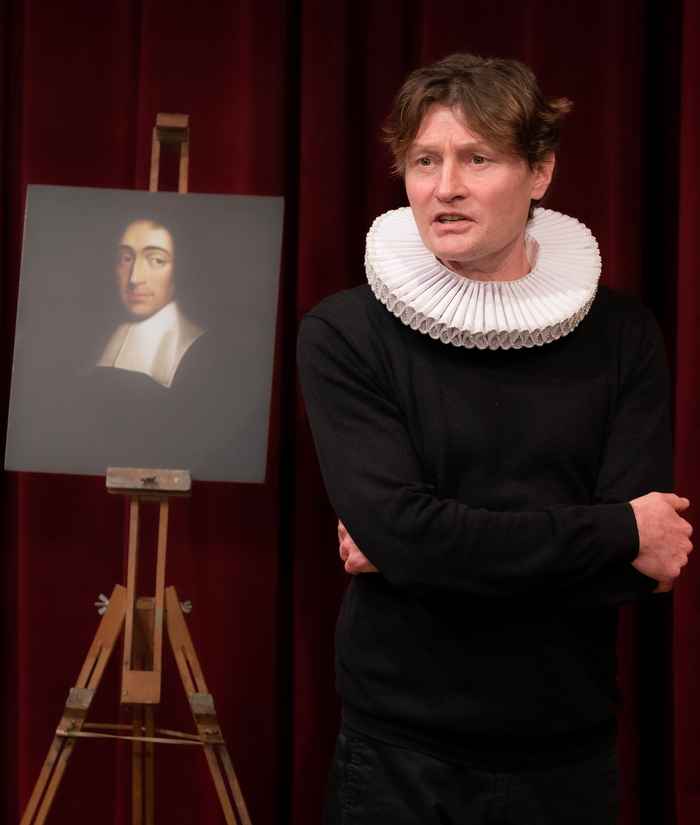
Harpert Michielsen is not himself a philosopher, but a historian and theatre maker, which means he approaches Spinoza’s work as a curious layperson. He takes the audience on a remarkable journey of discovery through the life and thought of this new Dutchman from the seventeenth century. Harpert Michielsen studied History for three years at the University of Amsterdam (UvA), after which he transferred to the Academy of Theatre in Maastricht.