Alumnus Tess Heeremans wins Ig Nobel Prize for Research on Drunken Worms
12 september 2024
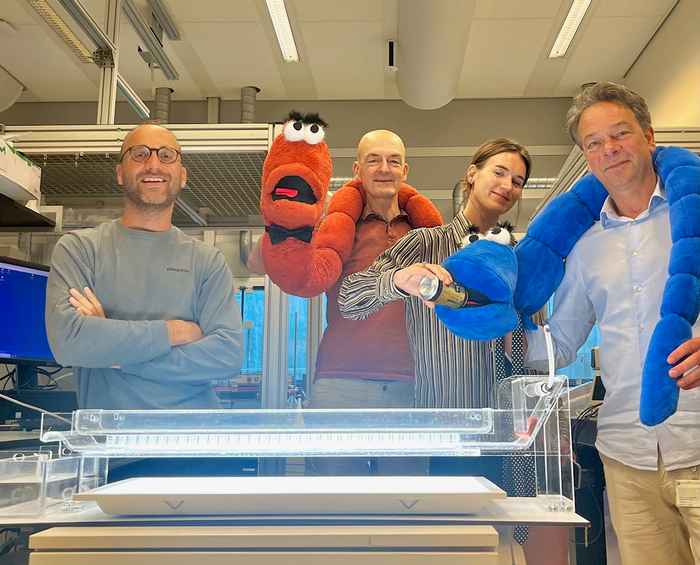
Heeremans' research, conducted in collaboration with physicists Antoine Deblais and Daniel Bonn, as well as physical chemist Sander Woutersen, focuses on the properties of active matter. This type of matter displays collective behaviour, similar to the way birds flock or fish school—phenomena that scientists still do not fully understand. By making Tubifex worms slightly inebriated, the team sought to examine how their movement patterns would be affected.
4.5% alcohol was enough, about the same amount as a beer. They function best at that level
The idea to use worms came from Woutersen, who recalled using them as fish food in his childhood and saw their similarity to active matter. To make some of the worms inactive, they decided to feed them alcohol. ‘4.5% alcohol was enough, about the same amount as a beer. They function best at that level. Incidentally, with a splash of water, they sober up again within 10 minutes,’ says Heeremans.
Sleeping Next to Drunken Worms
Then came spring 2020, and the pandemic brought with it strict lockdown measures. With the lab closed, continuing the research seemed impossible. ‘I didn’t want to stop,’ says Heeremans. She moved the maze setup to her dorm room and completed the experiments there. That’s how she ended up sleeping next to the drunken worms in their maze. Although not for long—after a while, the stagnant water began to smell, forcing Heeremans to stay at her boyfriend’s place overnight.
Big News on Javastraat
Over the years, the Ig Nobel Prize has evolved from a quirky parody to a respected accolade for innovative research. So, how does one react to winning such a prize? ‘Daniel and Antoine called me and said, 'Tess, we have a surprise for you. Please sit down.' I thought: 'Why do I have to sit down?' But I put my bike down anyway and found a bench on Javastraat.’ It was there that she received the big news. The announcement was so surprising that she didn’t quite believe it at first and kept it to herself for a while to avoid any leaks, which could have led to disqualification.
‘It was really tough keeping it to myself. I only told my best friend and my boyfriend. My mother didn’t even know until last Sunday. I was protecting myself, really.’
The Ig Nobel Prize
The Ig Nobel Prize, awarded annually to research that first makes you laugh, then makes you think, represents a significant recognition of the innovative work done by Heeremans and her team in understanding complex phenomena in physics. This year, two University of Amsterdam teams received the award: in addition to the ‘Drunken Worms’ team, the 'Head-of-Mint' team also won.