Misparked Bikes and Broken Elevators: €3.8M Research Project Boosts Accessibility in Dutch Cities
3 september 2025
Hamed Alavi is a computer scientist at the Informatics Institute. He studies how technology and design can shape the way we live in cities and buildings. His work focuses on making future ‘smart cities’ fair and inclusive for people and the environment. He is leading a research project called BEAT, which has recently been awarded €3.8 million in funding.
What problem does this project address, and why is it crucial?
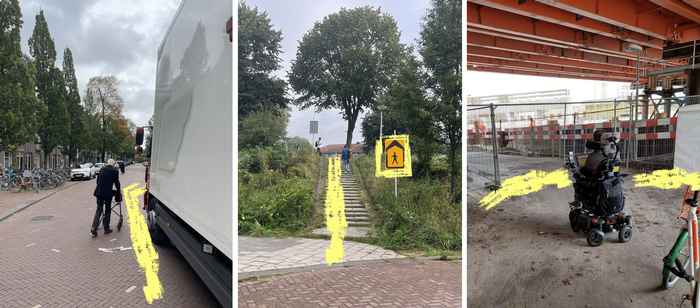
Alavi: 'Examples are plenty, from misparked bikes and delivery vehicles that block the sidewalk to over 200 ongoing roadworks and construction projects on Amsterdam’s streets alone. Our daily mobility is fraught with a wide span of barriers that often remain unregistered and overlooked. Individually, these barriers might be perceived as mundane or temporary, but together they form the permanent reality of our cities. They create a ‘permanent state of exception’ (in philoshopher Giorgio Agamben’s term). The first defining characteristic of these barriers is that they are pervasive; the second is their far-reaching impact. For some, a broken elevator in the train station may be only a matter of inconvenience, but for many others, this can mean compromising safety or essentially not being able to complete the journey, creating knock-on effects on autonomy, education and work opportunities, leisure, and more broadly, active participation in society.'
What are the objectives of the project?
Alavi: 'The broad aim of this project is to map and eliminate urban mobility barriers as they manifest in the daily activities of people. Dutch urban and suburban environments are the first targets; however, the aspiration is to expand this approach to other cities around the world. Operating from the standpoint that mobility is experienced in a different way by everyone, this project investigates urban mobility barriers as they unfold in people’s everyday lives. Contrary to dominant approaches that focus on a specific mode of mobility (e.g., public transport, walking) or a single accessibility barrier, this project introduces a new paradigm that examines the holistic experience of urban mobility for individuals with physical and cognitive diversities. The point of departure in this is the way people go about their day in these cities, their routines and travel behaviours, their daily frustrations with mobility obstacles, and the impact of these hindrances on their personal, social, and professional lives.'
How are you going to achieve those goals?
Alavi: 'Our approach centres on building close, collaborative partnerships with target groups through the creation of Living Labs. Each Lab, linked to a Dutch municipality, will serve as a platform for jointly identifying problems and priorities, and for co-designing and testing solutions in real life with active community and multi-stakeholder participation. This project’s contribution is twofold. We try to get a comprehensive understanding of barriers, their impacts and root causes in our cities. And then translate that knowledge to work on concrete solutions.
We:
- Create empowering tools to help individuals navigate urban mobility barriers;
- Design instruments that enable urban planners to asses accessibility based on the actual experience of the people that pass through the city;
- Offer evidence based guideline and policie-proposals;
- Raise awareness and actively involve citizens in the process and their outcomes.'