Commemoration as a tool of power in Hungary
25 februari 2026
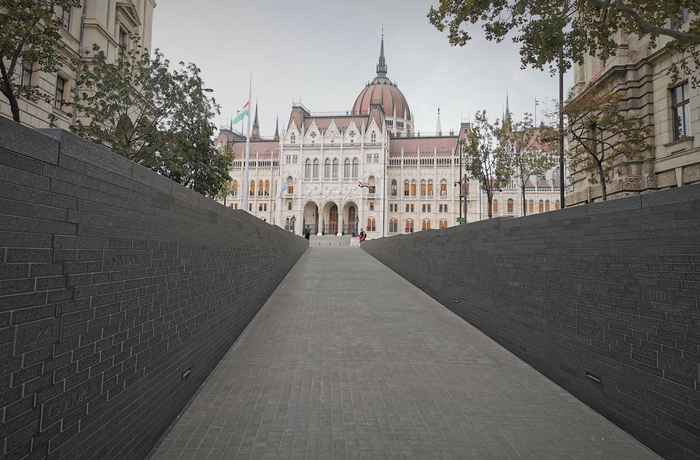
Since 2010, Hungary has seen large-scale interventions in museums, memorial sites and public commemorations, reshaping the national narrative. For instance, the area around the Hungarian parliament in Budapest was redesigned to align with a conservative-nationalist interpretation of history. Another example is the controversial Memorial for Victims of the German Occupation, erected (but never officially unveiled) in 2014 on Liberty Square. The monument suggests that Hungary was solely a victim of Nazi Germany, thereby pushing Hungary’s shared responsibility for the persecution of Jews into the background.
Univocal and nationalist
‘The interventions in the cultural landscape fit into a broader shift from a complex and multi-voiced historical narrative towards a univocal, nationalist victimhood narrative,’ Deim explains. ‘Museums also play an important role in this. The House of Terror Museum in Budapest, for example, strongly emphasises Hungary’s position as a victim of communism, within a broader story of twentieth-century oppression. In doing so, the museum supports an ideological framework in which national sovereignty, Christian identity and traditional values are central.’
Critical of the EU
The Orbán regime does not focus ideologically only on national pride, Christian identity and past victimhood. Deim says: ‘Resistance against perceived foreign interference by the European Union also plays a central role. Orbán wants to show the world that Hungary is not simply following the lead of Western European leaders.’
By systematically restructuring the memory landscape, the regime is working towards what Orbán himself calls a ‘new cultural era’. With growing state control over cultural institutions also limiting the space for alternative perspectives.
Counter-narratives
Yet counter-narratives do exist. Around the Memorial for Victims of the German Occupation, the Living Memorial emerged: a citizen-organised site of remembrance featuring personal objects, photographs and stories of Holocaust victims. The removal of the statue of Imre Nagy, the reform-minded prime minister during the 1956 Hungarian Uprising, also sparked artistic protest actions. According to Deim, these forms of activism show that remembrance culture is not fixed, but a dynamic process in which different groups struggle over meaning. Memory activism continues, but is becoming increasingly powerless, partly due to severe cutbacks in cultural funding.
Elections ahead
Deim’s research is particularly timely as Hungary heads towards national elections. Polls indicate a neck-and-neck race: it is roughly fifty-fifty whether Orbán’s party Fidesz will win again, or whether the opposition party Tisza, led by Péter Magyar, will come to power. ‘If the opposition wins, this will likely mean less direct state control and greater institutional autonomy. That could also lead to a different course in memory policy,’ Deim concludes.