Breaking up of swan families in winter disrupts spring migration
21 augustus 2026
Using GPS transmitters and DNA analysis, Hans Linssen and his colleagues analysed 55 swans – both adult and juvenile – from 12 entire swan families. This gave the researchers insight into family ties, how long families stayed together, and what happened when the bond was broken.
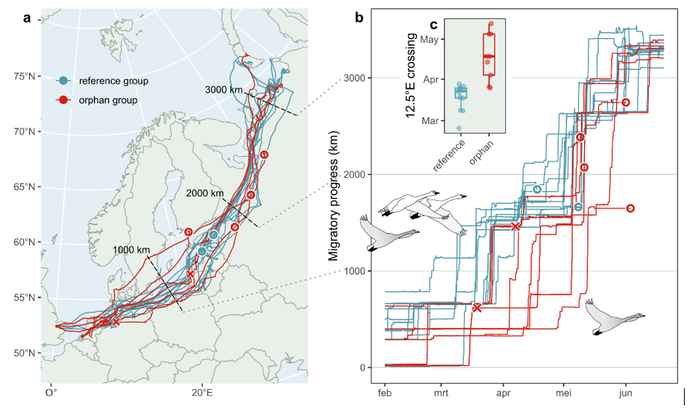
Bewick's swans breed on the Arctic tundra of European Russia, and in the autumn, they fly in family groups to the Netherlands and surrounding countries to spend the winter. Normally, the families stay together until at least halfway through the young's first spring migration back to the north, when the young are nearly one year old. For ten of the 24 young in the study, things turned out differently: they lost their parents during the winter following disturbances at roosting and feeding sites, primarily because hunters invaded a protected nature reserve important to the swans. On average, these orphaned swans departed for the spring migration nearly a month later than other juvenile swans and were much less likely to survive the following winter. The survival rate of the orphans dropped from 86 percent to 40 percent compared to young that stayed with their parents for the majority of the migration.
‘This poignantly shows that living and learning in a family group is not only useful for the young swans, but literally of vital importance,’ says Linssen.
Disappearing over Latvia
One orphaned swan did not leave northern Germany until April, following the same route as its peers but flying a considerable distance behind them. The last GPS signal was picked up over Latvia; after that, the swan disappeared from all records. For several young orphans, the transmitter signal was never picked up again, indicating that they did not survive the summer.
Linssen: ‘There is no telephone network in the swans’ breeding area. As a result, the GPS transmitters cannot send their locations for months. So, during that period, we do not know how the swans are doing. We only receive signals again when they migrate south in October and we regain coverage. Then we see which animals survived the summer. Unfortunately, for most of the orphaned young, such a signal failed to arrive.’
Orphan swan in a foster family
One of the young swans in the study, 036T, presented a more hopeful story. The swan’s mother was shot by hunters at their wintering grounds. In February, 036T left for Great Britain, where she joined another family. For two weeks, the young swan travelled with this family across British fields and later towards northern Germany, until the bond was broken in mid-March. On 26 March, 036T began the spring migration independently, somewhat on the late side. Then, in September, she met her biological father again in the Russian Arctic. They subsequently travelled south together for another week. Five years later, 036T is still alive.
Declining population
The findings are particularly concerning because the population of Bewick's swans in northwest Europe has been declining for years. Increased mortality among young birds can only exacerbate this decline. The study emphasises that protecting the birds is not just about nature reserves where they can live, but also about peace and quiet during the winter and the first spring migration. Linssen: 'It is crucial for young swans to be able to spend at least their first winter and spring migration with their family. Disturbances during that vulnerable period can have fatal consequences, so we must keep them to a minimum.'
Publication details
Hans Linssen, Emiel van Loon, Robert Wilson, Sarah Sonsthagen, Götz Eichhorn, Judy Shamoun-Baranes & Bart Nolet: 'Family life is critical for migration and survival in a long-lived social bird', in: Behavioral Ecology and Sociobiology (20 August 2026). https://doi.org/10.1007/s00265-026-03787-5