Introduction to Machine Learning II
Ready to take your machine learning skills to the next level? Dive deeper into neural networks and deep learning fundamentals in this 12-week course.
Deep dive into modern neural networks
Hands-on course
Learn to design and adapt model architectures
For whom?
Introduction to Machine Leanrning II builds on the knowledge and skills covered in the course Introduction to Machine Learning I. This couse is only open for professionals who have completed Introduction to Machine Learning I.
Required prior knowledge
Completion of the course Introduction to Machine Learning I.
-
Course description
This course is a continuation of Introduction to Machine Learning I and provides a deeper look into modern machine learning techniques and, more specifically, neural networks. Participants will explore how these models learn from data, how predictions are generated and improved, and how neural network architectures are designed for different types of machine learning tasks.
Topics include:
- Module 1: Logistic Regression, Interpreting results with learning curves
- Module 2: Neural Networks; Model representation, Forward Computation, Motivation for hidden layers
- Module 3: Neural Networks Backpropagation; Learning network weights with multiple hidden layers
- Module 4: Convolutions for image processing, Convolutional Neural Networks, Pooling, Building modern neural networks
- Module 5: Dropout, Batch normalization, Data augmentation, Using TensorFlow to design deep neural networks
The course focuses on the fundamental concepts and techniques that provide a foundation for understanding modern deep learning approaches, included using them in image processing, however, won't cover recent innovations in text generation by Large Language Models.
-
After this course:
- You are able to use machine learning libraries to solve AI problems based on real data.
- You are familiar with several commonly applied machine learning models, such as logistic regression and (deep) neural networks.
- You can make and motivate a choice for a specific model based on a problem description.
- You can evaluate a learned model based on training and validation results, and based on this analysis make a suggestion to improve the model.
- You can determine what the hyper-parameters are that influence the complexity of a specific model and determine a strategy to optimize these parameters.
- For a specific model, you can indicate the exact function or value that is optimized by the model, how that optimum is found and what the possible limitations are.
-
Course design
Every module consists of 2 or 3 weeks. This course consists of 5 modules.
Every module has one session with mandatory attendance. In total there are 5 on-site mandatory sessions scheduled on Tuesdays from 14:00 - 16:00. Online participation is not possible.
On the weeks where there are no scheduled lectures, participants can come and ask questions during the Q&A sessions. There will be several timeslots scheduled for Q&A sessions every day those weeks, so participants may choose whichever option fits their schedule best.
In total, the course will average around 8 hours per week. This is a 12-week course, with sessions held every two weeks.
Click here to download the full session schedule (PDF).
-
Assessment
The course includes programming assignments, writing assignments and a final exam. You must succesfully complete all of these to pass the course.
-
Study material & laptop
Study material: The study materials included in the course consist of reading materials, theory videos, and assignments.
Laptop: You will need to bring your own laptop to program on for the assignments (make sure you have rights to install software on the device).
Q&A sessions
In the weeks with Q&A sessions there will be several timeslots to ask any additional questions you might have about the material. These are optional and you may attend whichever slot fits your schedule best. Timeslots are as follow:
- Monday 13:00-16:30
- Tuesday 10:00-13:00
- Wednesday 10:00-13:00
- Thursday 10:00-13:00
- Friday 10:00-13:00
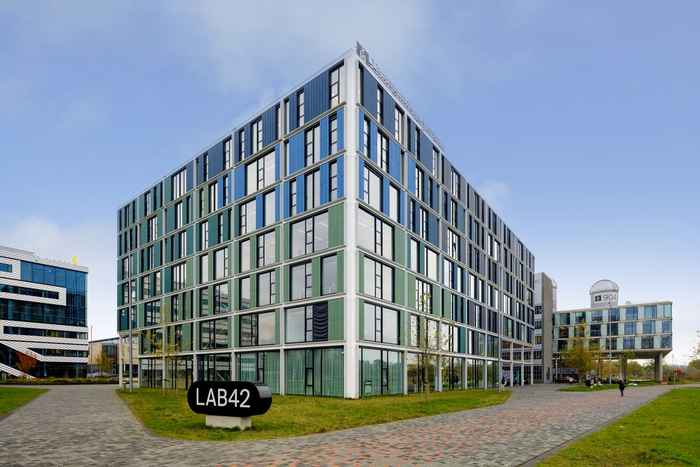
The course will be held at Amsterdam Science Park in LAB42, an international hub for knowledge and talent development in digital innovation and AI. LAB42 is a vibrant space where AI researchers, computer scientists, students, and entrepreneurs come together to explore and advance the possibilities of artificial intelligence.
Contact
Do you have questions about this course? Please contact us: professionaleducation-ivi@uva.nl