‘From the moment I started researching sexual transgressive behaviour, it stuck with me. Over the past ten years, I’ve specialised in this area.’
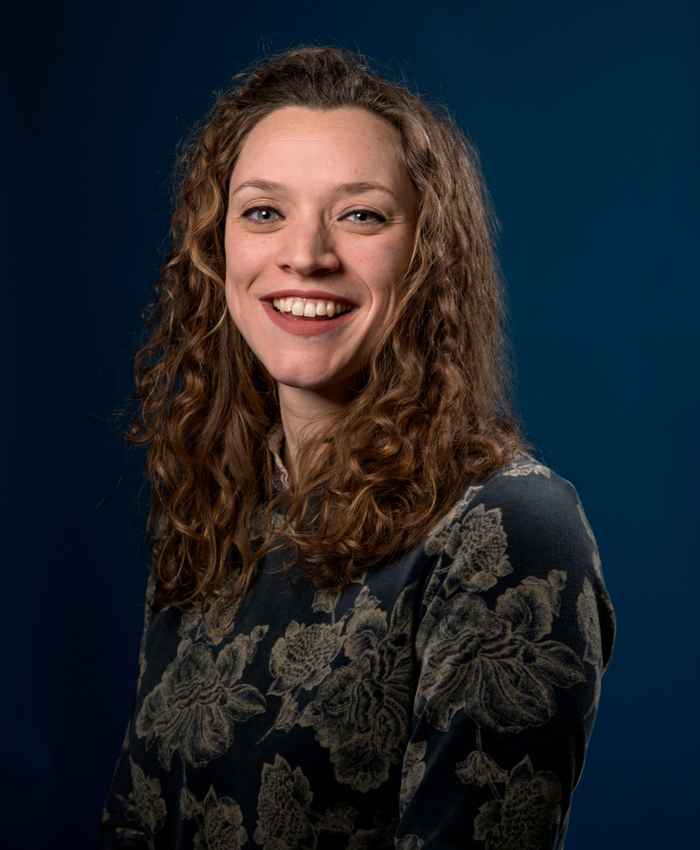
Eveline, programme manager and team manager at de Waag
Initially, the Research Master’s wasn’t a super well-thought-out decision. I actually ended up there because, at the time, it was the only Master’s that lasted two years.
I also felt unsure about the clinical side. Honestly, I never saw myself as a therapist, even though I studied psychology. I don’t think I have the patience for it. I was more drawn to the brain and neuropsychology side of things, so I chose to do the Research Master’s with a Brain & Cognition major.
The programme definitely prepares you for a research career, but I didn’t go into it thinking, ‘I want to do a PhD.’
It turns out I really enjoyed doing research.
The Research Master requires two internships: a research internship in the first year and a thesis internship in the second.
I did my first internship at a youth detention centre and my second at a forensic psychiatric clinic, De Waag, working with someone researching sexually transgressive behaviour. I loved doing research in that setting! That’s when my passion for research really ignited.
I graduated during a time when jobs were scarce, but I stayed on at my internship. Then a project manager position opened up, a bit of a jack-of-all-trades role. It was a good starting position, but I realised quite quickly that I wanted a challenge.
So I said, “I think I’d like to pursue a PhD.”
I had a great connection with my internship mentor, who became my co-promoter. It took some time to get everything set up, but eventually I started my PhD at Maastricht University, while I kept on working at De Waag. Fun fact: I only physically went to the university for my PhD defence.
My PhD focused on how sexual deviance develops, that is, atypical sexual interests. It examined this from a forensic perspective, but also more broadly: how does this happen in society at large? Because I believe it’s all on the same spectrum.
At some point, you become a specialist, and if you really enjoy what you do, you just keep at it.
From the moment I started researching sexual transgressive behaviour, it really stuck with me. Over the past ten years, I’ve specialised in this area. At some point, you become a specialist, and if you really enjoy what you do, you just keep at it.
I also regularly give lectures and talks. It’s always a topic that generates interest, but I have to be mindful. After ten years working with this population, I realise it’s a tough subject, and not everyone finds it easy to engage with. So, I always try to keep that in mind.
After finishing my PhD, I transitioned to my current job, which combines two roles.
I’m the team manager of one of our Sexual Transgressive Behaviour teams and also a programme manager for the 12 locations of de Waag. As a programme manager I’m responsible for making sure the care pathway for sexually transgressive behaviour is as solid as possible, that it’s grounded in the latest scientific findings, that knowledge is shared effectively, and that everyone is well trained.
I actually enjoy this practical side of science, and I’m really passionate about the cross-pollination between research and practice.
Not just the dry theory, but also: how do people actually experience it? What does it look like in practice? How can you bring those together? How do you communicate it as effectively as possible? That’s really what I love doing. And that’s exactly what this job offers me.
I found that academic settings can feel distant from everyday practice.
It's also one of the reasons I wanted to do hands-on work in practice. While I appreciate the valuable foundation the university and the Research Master’s provided, I found that academic settings can be different from everyday practice.
I was eager to take the next step and immerse myself more directly in practical work where I could see the real impact of what I do.
The Research Master's has taught me valuable skills.
Skills I still use, maybe not daily, but regularly, include programming basics. I’m not an IT person, but I learned some basic programming that helped me a lot, especially in running experiments.
I also learned to work with SPSS and write syntax. I learned R during the Research Master, though I haven’t used it much since, which is a shame, really, because it’s a great tool.
More broadly, the research skills like critical reading and writing have been invaluable. I loved the Scientific Writing and Presenting course. That’s probably the skill I use most: how to write scientifically but in an accessible way.
Science tends to come with a dry, difficult writing. I aim to write clearly and understandable for a diverse audience. Because I’m at that crossroads of science and practice, whenever we publish research, I also make sure to translate it for the workplace: writing summaries for LinkedIn, including it in internal trainings, and weaving it into our organisational communication.
My advice? Always do internships, talk to professionals, or simply go and see what’s out there.
Most people love sharing their work and will happily let you tag along for a day. So just get out and explore.
I personally gained so much from my internships, not only discovering what I enjoyed, but also what I didn’t. That’s invaluable when it comes to finding your own path.