‘A lot of people assume academic skills are only useful in academia. But actually, they’re incredibly useful outside of it too.’
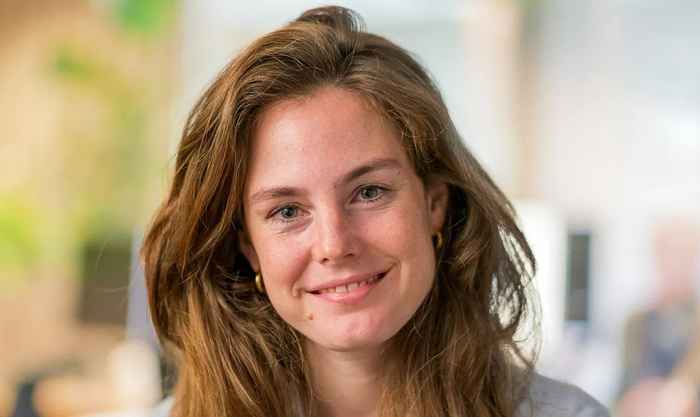
Renske, advisor on societal challenges in the public sector
To PhD or not to PhD?
After the Research Master's, I planned to do a PhD and work in mental health care. But I started to have doubts. Did I really want to spend four years on one topic? Would that make me happy? I realised I missed variety and a broader scope.
I enjoyed the work, but in the end, academia didn’t feel like the right fit for me. I found that the academic system, with its focus on publishing and long timelines, didn’t align with what energises me most. That’s not to say it isn’t the right environment for others, but for me, it was a sign to explore different paths.
Fortunately, I already had some idea of what strategy consulting involved. And I thought: If I’m unsure about my next step, this could be a great way to learn and explore. So I gave it a try.
From consultancy to the public sector
I joined a strategy consultancy firm in Amsterdam and London. That’s where I learned the business side of things: how to break down a problem, quickly formulate hypotheses, turn them into something measurable, synthesise information, and derive recommendations from them in a pragmatic manner. Those skills were incredibly useful.
Later on, I moved towards the public sector, because I wanted to contribute to the common good in a more direct way. I worked at the Ministry of Finance, where I worked on improving the national policy evaluation system. That meant overseeing all research and policy evaluations across different ministries, and developing tools to increase the quality of these studies and how they are used to improve the policies at hand. Again, a research-heavy role, but in a totally different setting.
I’ve always had jobs that involve research, but in applied, practical ways, across various contexts.
Also, I joined a different agency where I worked directly with citizens, looking at why people get stuck in bureaucracy and how systems can be improved. So I’ve always had jobs that involve research, but in applied, practical ways, across various contexts.
I currently work as an advisor at a firm called Andersson Elffers Felix, which focuses on societal challenges.
We’re hired by public and semi-public organisations to help improve policies, services, organisations, and systems. This involves research or policy evaluation, but also broader strategic and organisational work.
For example, I worked with the Ministry of Health, Welfare and Sports on scaling up a mental health initiative. We tackled questions like: What should it look like? How should this be implemented nationwide? Who’s responsible? How do we fund it?
We worked with professionals and experts from across the field and supported strategic decision making. I still work on themes related to psychology, but now I operate at a more systemic level.
The skills I learned during my studies are still very relevant.
The analytical skills I gained during the research master are still a big part of how I work. That empirical way of thinking (starting with a theory or hypothesis, then operationalising, measuring, analysing) is still my foundation. The main difference is now it’s more pragmatic. I’m not running four-year RCTs. The research I do is more practical.
When you come out of a Research Master's, pragmatic thinking doesn’t always come naturally. In research, you aim for precision and completeness. In organisations, you often have to make decisions with only 80% of the information.
That 80/20 rule became really valuable: you can get most of the insights fairly quickly, and more effort doesn’t necessarily lead to that much added value in terms of results.
It’s much easier to start with a strong academic foundation and then learn to be pragmatic, than the other way around.
However, the mindset stays the same. If we want to understand the needs or preferences of a large group, how do we sample it well? It doesn’t have to be scientifically perfect, but it needs to make sense.
Do we use a survey, interviews, focus groups, or quantitative population data? I still apply those questions daily. A lot of people assume academic skills are only useful in academia. But actually, they’re incredibly useful outside of it too.
That said, it’s much easier to start with a strong academic foundation and then learn to be pragmatic, than the other way around. Because you’ll never again be as thoroughly trained in doing research as you are during a programme like this.
Learning to think more pragmatically came with experience. But I still rely on the Master's research mindset every day. Now, it feels like the best of both worlds.
Nothing about my path was carefully planned.
I just kept following my interests. But I will say this, and I think this is useful for students now: I always did a lot alongside my studies. I ran a small business, took on board roles, all kinds of things. I think that helped me switch between sectors more easily.
At the same time, I’m aware it might be more challenging for students now. There’s more pressure to graduate quickly, and fewer financial resources. Still, I’d advise you to develop yourself outside of your degree. Personally, not just academically. Follow your interests, not just what’s expected, outside and inside the Master’s programme. To me, it made it a fun, energising, and rewarding journey.