Haroon Ali: 'I'm happy that there are more and more role models for bicultural queers'
A quest for queer and bicultural identity
3 augustus 2023
Coming out
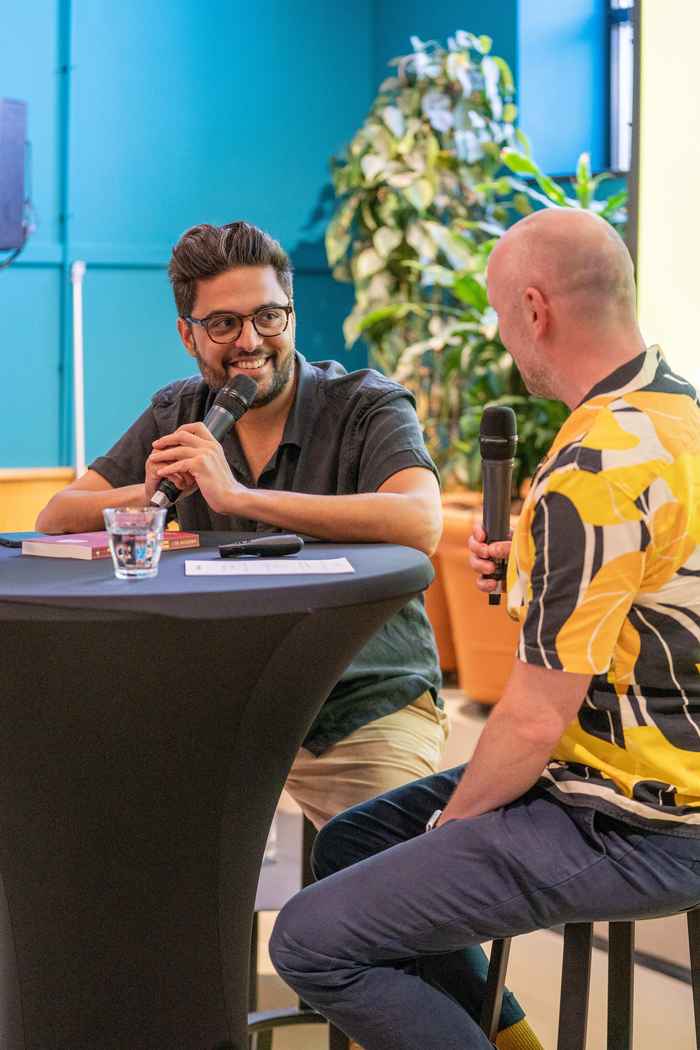
'I actually came out relatively late because I already knew I was attracted to boys for ten years,' Ali says on the stage of Pride University, a collaboration between the University of Amsterdam (UvA), Vrije Universiteit Amsterdam (VU), Inholland, and ROC Amsterdam. He grew up in Amsterdam-Osdorp and attended a high school where he couldn't find the courage to say he was gay. It took an exchange programme to Toronto during his of (Social) Psychology bachelor at the UvA for him to be honest about being attracted to boys. 'Apparently, I had to go to Canada to break free. It felt safe there. Before going to Canada, I was actually quite shy and insecure, but I came back from Toronto with so much energy and zest for life. At that point, I really wanted to shout from the rooftops that I was gay.'
Bicultural and queer
Back in Amsterdam, Ali decided to come out at the age of 21. First to his friends, and then to his parents. In his debut book Half, Ali describes how he left a letter under his parents' pillow to tell them he is gay. He also immediately distanced himself from Islam because being gay and Muslim seemed like an impossible combination to him. He now looks at it differently, he explains. 'You don't necessarily have to choose between faith and the freedom to be yourself. But when I came out twenty years ago, I had no examples of Islamic queers. So, I thought I couldn't be Muslim anymore if I was gay. In 2022, I made a documentary about it, titled The M-Word' (in Dutch).
Role model
There is now more attention for the intersection of bicultural and queer identities. Ali: 'Activism within the LGBTQI+ community was predominantly white for a long time, but fortunately, you see much more diversity now and hear different stories. A growing group of people is showing what it's like to be bicultural and queer.' He plays that role himself: Ali receives many messages from Islamic queers sharing their stories. 'It's a challenging position; as a queer Muslim, you face difficulties in the Netherlands because many Muslims do not accept homosexuality, while LGBTQ+ people don't understand why you'd want to remain Muslim. Fortunately, there are more and more role models for people struggling with these identities, showing how you can find freedom to be yourself.'
About Haroon Ali
Haroon Ali is a freelance journalist, interviewer, essayist, and columnist for various newspapers and magazines. He mainly writes about culture, diversity, and the zeitgeist. Ali has a Pakistani father and a Dutch mother and was raised as a Muslim. He renounced his faith when he came out as gay at the age of 21. Ali wrote about these conflicting identities in his non-fiction book 'Half,' published in September 2020 by De Bezige Bij. He is currently working on his second book, 'Spectrum,' which focuses on the rainbow community in the 21st century, scheduled for release this November. Ali completed two master's degrees at the UvA: Social Psychology in 2006 and Journalism & Media in 2009.
Pride at the University of Amsterdam
The University of Amsterdam has its own platform for the LGBTQ+ community and allies who work or study at the University of Amsterdam. UvA Pride is a social network, knowledge center, and emancipation movement for the LGBTQ+ community.