Rethinking the Gut Microbiome: Health Is Not About Staying the Same
8 april 2026
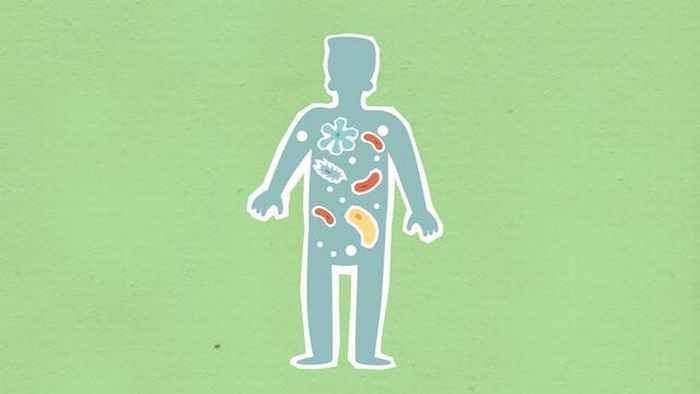
According to Sahar El Aidy, Professor of Microbiome Engineering at the University of Amsterdam, part of the problem may lie not in the microbiome itself, but in how we define what it means to be 'healthy.' 'We often think of the microbiome as something that should return to a fixed, balanced state', she explains. 'But that assumption may be holding us back.'
A conceptual shift
In a new perspective developed in collaboration with philosophers, El Aidy proposes a different framework: Adaptive Coherence.
'The collaboration was not incidental,' says El Aidy. 'It helped unpack and critically examine widely used terms such as balance, diversity and resilience, which often carry multiple meanings and guide research in inconsistent ways.'
Adaptive Coherence reframes microbiome health not as a stable or ideal composition, but as the capacity of the system to reorganize in response to changing conditions in the gut environment while maintaining function. 'This is not about finding the perfect microbiome,' says El Aidy. 'It’s about understanding how the system keeps working, even as it changes.'
Why this matters
This shift helps explain a persistent puzzle: why microbiome-based treatments often work in some individuals but not in others.
Two people can have very different microbial compositions and still be healthy. Conversely, a microbiome that appears 'normal' may fail to support proper function. What matters, in this view, is not simply which microbes are present, but how they are organized and how they reorganize in response to changing conditions while maintaining essential functions.
Think of it as an orchestra; if one musician drops out, the music does not stop. The remaining players adjust to each other and to the acoustics and tempo, allowing the piece to continue, sometimes in a different but still coherent form. What matters is not the individual musicians, but how they coordinate to sustain the music.
Looking differently at the same data
Much of microbiome research relies on stool samples, a valuable and non-invasive tool. But these samples primarily capture a trace of past activity, rather than the ongoing dynamics inside the gut where conditions such as nutrient availability, immune activity, and chemical gradients, such as acidity, are constantly changing.
'Stool samples are extremely useful,' El Aidy notes. 'But we need to ask better questions of them.' Microbes are embedded in a constantly changing system that they must continuously respond to. Rather than focusing only on which microbes are present, newer approaches extract system-level signals from how microbial interactions are organized. For example, the balance between cooperative and competitive interactions can distinguish healthy from diseased states, even when overall composition appears similar.
Within this context, the concept Adaptive Coherence provides a way to interpret these patterns: not as static markers, but as indicators of a system’s ability to maintain functional integrity under changing conditions.
Toward better understanding and application
This perspective suggests a shift in how microbiome-based interventions are approached. Instead of trying to restore a predefined 'healthy' composition, the focus may move toward supporting the system’s capacity to adapt, its ability to reorganize while preserving essential functions.
This perspective also changes how microbiome health might be measured and monitored, moving from static snapshots toward dynamic indicators of functional organization and adaptability. 'The goal is not to force the microbiome back to a previous state,' says El Aidy. 'It’s to support its ability to function and adapt in the face of change. That’s what health looks like.'