Recognition and rewards
At our university, research is conducted, teaching is delivered and contributions are made to important societal challenges in various ways, in teams and in collaboration with societal partners and businesses. Science thrives on diverse talent and collaboration, requiring a broad range of skills. However, does this diversity sufficiently reflect in the criteria and policies we use to attract individuals and shape their careers?
UvA vision on Recognition & Rewards
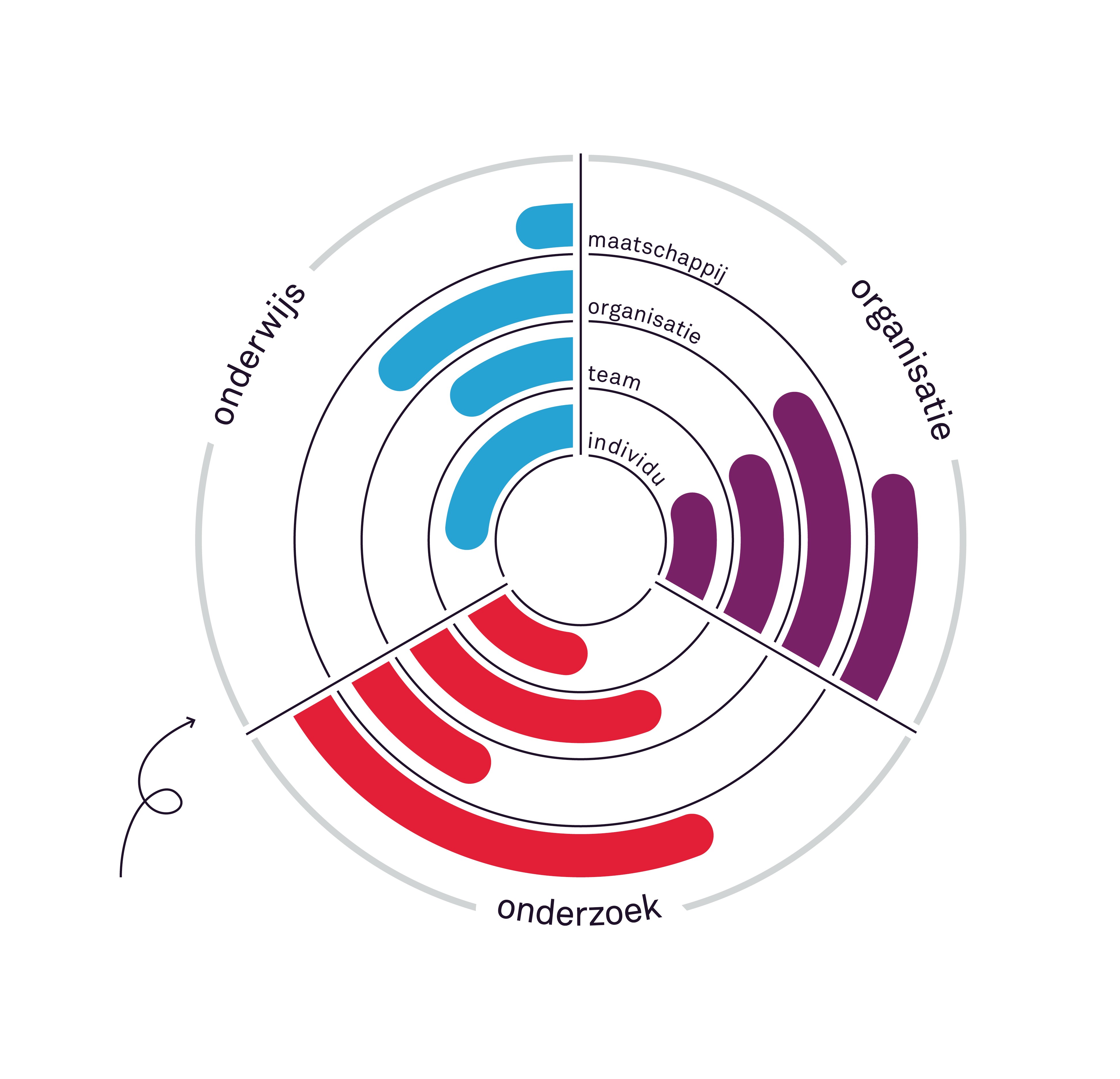
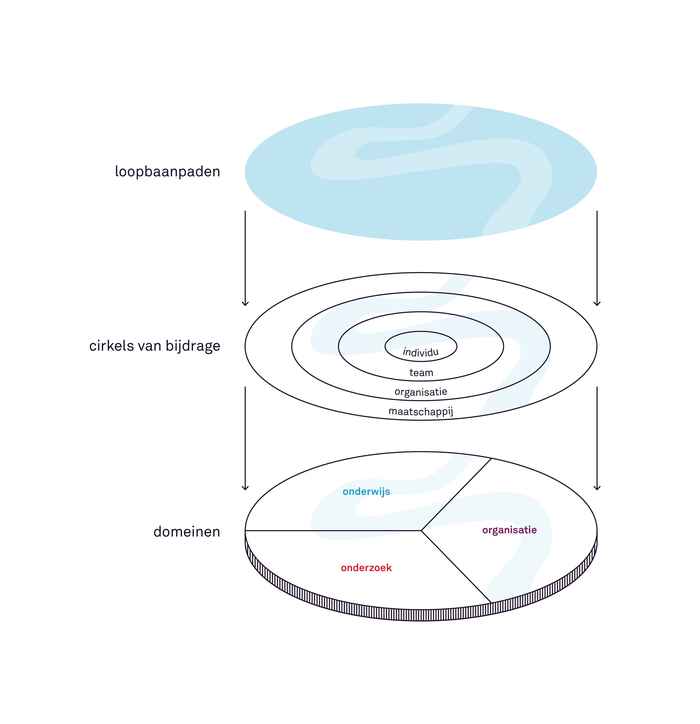
Excellence in academia takes many forms. Academic careers can develop with different emphases across a wide spectrum of academic tasks. Therefore, the focus is shifting from a sometimes narrow emphasis on publications to a broader appreciation of talents across all dimensions of academic work. The career development of academics is central to this. Academics shape their careers within the domains of teaching, research and organisation, as individuals, as team members, as university staff and as part of society. By differentiating career paths, we provide academics with more control over their own careers. They are given the opportunity to profile themselves across various core tasks or to specialise in a single core task. The emphasis can shift during a career.
This process, illustrated by the Career Radar (figure 1), is still under development. Careers can unfold in various ways, from meandering to more linear paths. With a design-oriented approach, we aim to enable this diversity in career paths with focuses on teaching, research, leadership and impact-oriented work.
We use the Career Radar as a unifying element in all initiatives and design sessions currently being organised.
From vision to change
This transition requires a fundamental change in both policy and culture. It necessitates new criteria and structures, as well as a shift in mindset within the academic community. We focus on:
- Expanding and scaling up initiatives from faculties and support services to develop policies, practices and tools. This is done through design sessions, university-wide seminars, workshops and experiments.
- Examples of outputs from these initiatives and design sessions include recommendations and implementation plans, frameworks and definitions, new working methods, improved processes, team agreements and quick wins that teams can immediately adopt.
- Our focus on creating differentiation and dynamism in career paths also touches on the other key areas of Recognition and Rewards: focus on quality, balance between individual and collective, leadership and open science. We choose an integrated and iterative approach that allows us to stimulate, connect and further develop all aspects at the right moments.
- Providing input and building blocks for UvA-wide or faculty-specific policies on Recognition & Rewards, as staff from central support services (HR, Academic Affairs) actively participate in the initiatives and design sessions of faculty teams.
- Across the UvA, there are already initiatives and results contributing to a better balance in recognising and rewarding academics. We connect, inspire and strengthen each other through collaboration with faculty teams.
- We use the Career Radar as a unifying element in all initiatives and design sessions.
Content
The following themes are on the agenda for faculties:
- Diversification of career paths (using the Career Radar): attention to annual reviews, revised criteria for teaching, research and organisation. The Faculty of Law has conducted a design session on annual reviews, and the faculties of Law, Humanities, Social and Behavioural Sciences and Science are working on renewed annual reviews, coordinated by HR with support from the R&R programme team.
- Balance between individual and collective: definitions and practices for Team Science. The Faculty of Science has organised an initial inspiration and design session. Other faculties can draw from these experiences and organise similar sessions. In 2024, a UvA-wide seminar was held on societal impact, the place of impact in careers and the role of leadership.
- Leadership: the UvA has a Leadership programme that addresses various aspects of leadership. One focus area is the appreciation of the leadership role.
- Open Science: frameworks and definitions, criteria and conditions, appreciation of open science in promotions; through a UvA-wide seminar in 2025 and other meetings. The UvA is also starting an open science project as part of an NWO tender in 2025.

Recognition and Rewards Committee
Huub Dijstelbloem, Professor of Philosophy of Science, Technology and Politics and Scientific Director of the Institute for Advanced Study (IAS), is the Chair of Recognition and Rewards at the UvA. In total, ten ambassadors, together with the chair and project leader(s), form the UvA Recognition & Rewards Committee. The committee advises the board and the project organisation and focuses on facilitating discussions on Recognition & Rewards and supporting the change process within faculties.
More information or want to contribute?
Would you like to know more about Recognition & Rewards or contribute to its further development within the UvA? We invite staff to delve into this theme and share their ideas. If you have questions, suggestions or wish to be involved in the next steps, please send an email to erkennenwaarderen@uva.nl.