New CampAIgn Tracker reveals: 90% of AI election content has no label
17 March 2026
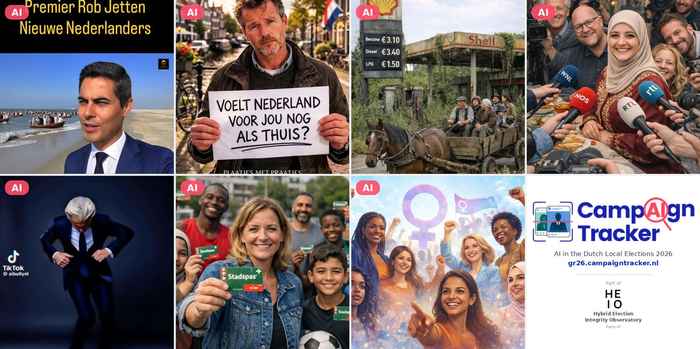
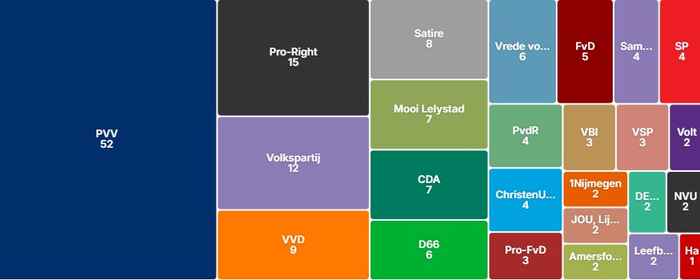
In just the first 10 days of monitoring, researchers flagged 192 posts containing AI-generated visuals, ranging from realistic deepfakes to AI-generated graphics. “PVV is once again the biggest producer, echoing our findings from the national elections,” says political communication researcher Fabio Votta, who coordinates the project.
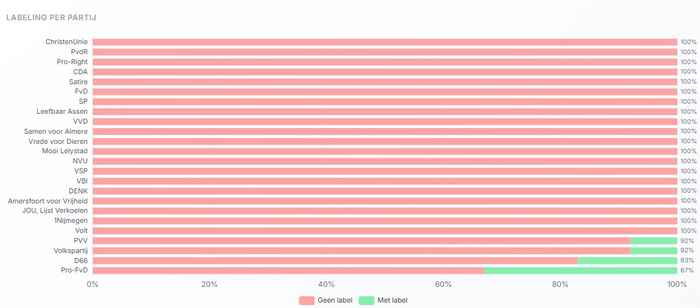
Overall, 90% of the AI-generated campaign content was posted without any form of AI label or disclosure, covering a wide range of topics, from immigration to personal branding.
As generative AI models are continuously getting better at producing visual content, it is important that voters know when the images are real or not, and not misled by artificial content.
"The EU AI Act that comes into full force in August 2026 will require labeling of AI-generated content, but as of now we find that the vast majority of AI campaign material carries no disclosure whatsoever," says Votta.
What the CampAIgn Tracker does
The CampAIgn Tracker analyses all posts on Facebook, Instagram, TikTok and X from political parties and candidates in 30 Dutch municipalities, supplemented with posts from national party accounts as well as selected influencers and commentators, during the 2026 Dutch municipal election campaign.
The monitoring dashboard shows how many AI-generated posts are being spread by which parties, whether AI labels are used, which actors are depicted, which topics are covered and whether the tone is positive or negative.
The tracker will be continuously updated as new data comes in.
Differences between cities
“For the first time, we are tracking the use of AI in election campaigning at the local level, allowing us to compare patterns between cities,” says Votta. “AI use is fairly distributed across all municipalities, However, Lelystad stands out with 46 AI items driven almost entirely by PVV candidates (37 of 46). Steenbergen follows with 12, all from a single local party (Volkspartij) posting AI slop content.”
Interactive tool: AI or Not?
Can you tell if an image is AI-generated?The researchers also created the interactive tool AI or Not to test your skills with real examples from the Dutch Local Elections 2026, at three difficulty levels: Interactive Tool AI or Not?
The CampAIgn Tracker is part of the Hybrid Election Integrity Observatory (HEIO) consortium, together with Post-X Society, Trollrensics, and AI Forensics. For questions regarding AI and elections please reach out to Fabio Votta (f.a.votta@uva.nl), Teresa Weikmann (t.e.weikmann@uva.nl), Simon Kruschinski (simon.kruschinski@gesis.org), Nicolas Mattis (n.m.mattis@uva.nl), Nicolas Mattis (n.m.mattis@uva.nl)