Corals in extreme coastal bays show greater resilience to climate stress
12 February 2026
Coral reefs are among the most biodiverse ecosystems on the planet and play a vital role in coastal protection, fisheries, and tourism. “They provide habitat for approximately 32% of all known marine species, despite occupying less than 0.1% of the ocean’s surface area,” Solomon explains.
Despite their importance, coral reefs are declining rapidly worldwide due to multiple threats, including climate change and local human pressures, such as pollution and excess nutrients in the water. “As the oceans warm, and marine heatwaves increase in frequency and severity, coral reefs are increasingly affected by large-scale bleaching events and mass mortality,” says Solomon.
Curaçao’s bays as natural laboratories
To better understand how corals can adapt to stressful conditions, Solomon studied corals in so-called ‘natural laboratories’: the more extreme coastal bays of Curaçao and the nearby more stable fringing reefs.
“In these coastal bays, corals already live under certain conditions similar to what we expect to see on a much larger scale in the future. The water is warmer, daily fluctuations in temperature, pH, and oxygen levels are greater, and human influence is stronger.”
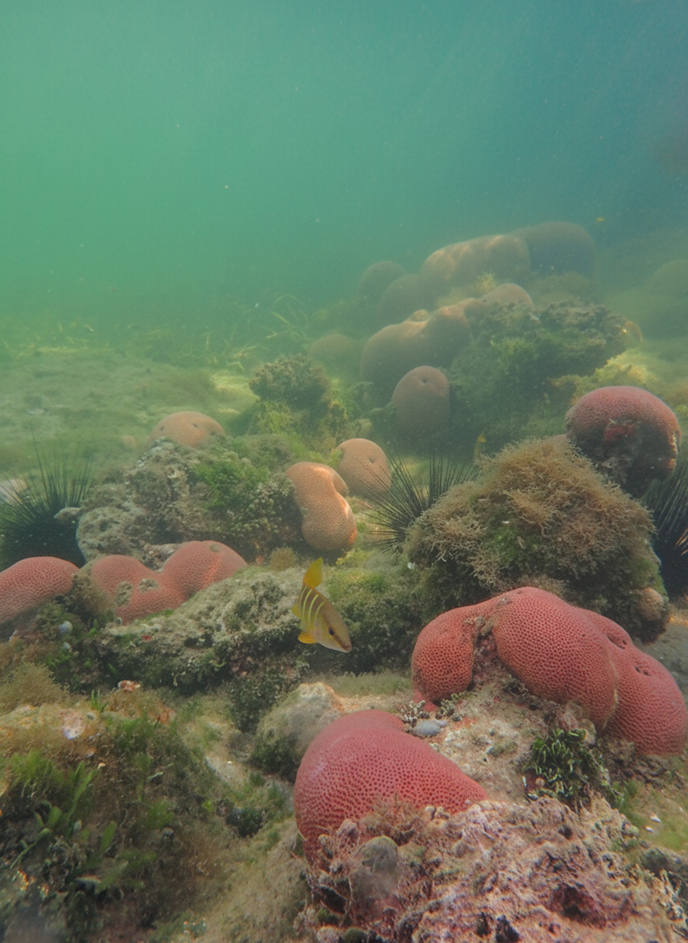
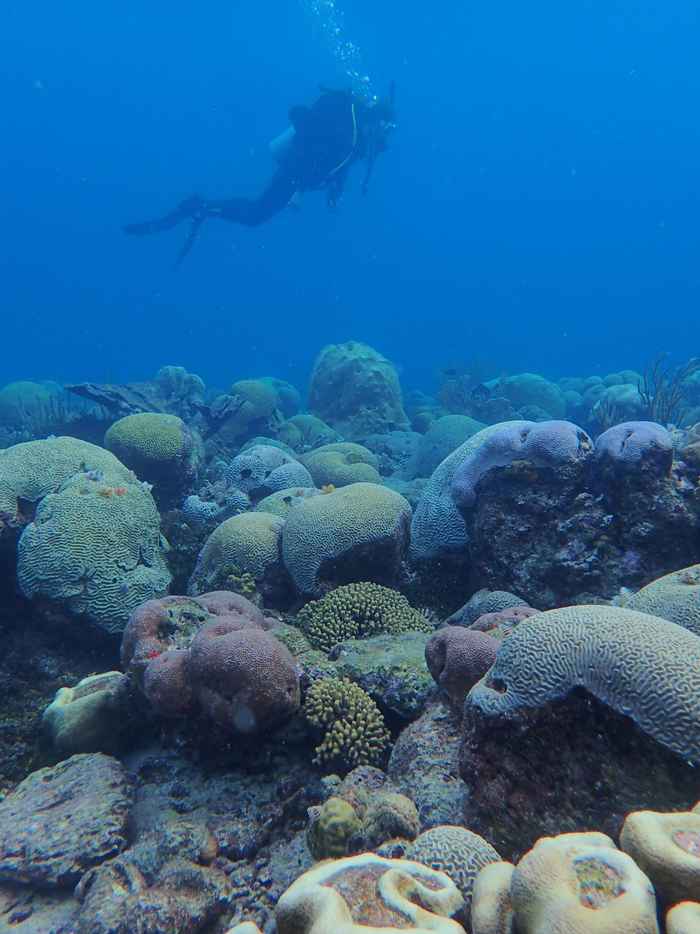
According to Solomon, these coastal bays have long been overlooked in coral research in the Dutch Caribbean, partly because they do not fit the classic image of a clear-water coral reef. “Because corals in these more extreme bays are exposed to a wide range of environmental conditions, they can offer important insights into the mechanisms behind resilience and survival under future ocean conditions.”
Flexible partnerships with algae and bacteria
It is precisely in these more extreme bays that some coral species appear to survive remarkably well. According to Solomon, this is partly because corals in these environments have flexible nutritional strategies, often live in symbiosis with more heat-tolerant algae, and host microbial communities that potentially contribute to their stress resistance.
“Corals obtain energy from sunlight via algae living in their tissues, but they also feed on particles in the water. Corals in the bays proved to be flexible in this respect: they adjust the way they ‘feed’ when conditions change, for example between dry and wet seasons.”
These traits help corals function under conditions that are detrimental or suboptimal to corals in many other reef systems.
Ability to adapt
Solomon also investigated the extent to which corals can adapt to new conditions. She conducted experiments in which corals were transplanted between bays and reefs and in which they were exposed to heat stress.
Corals originating from reefs were able to acclimatise to the harsher conditions in the bays and continued to survive and grow well, but this came at a cost: they expended more energy and showed a decline in overall health. Corals that naturally live in the bays, by contrast, are highly specialized to that environment and grew less well when transplanted to more benign and stable reefs.
In addition, bay corals were found to be naturally more resistant to heat, while one species from the reef demonstrated capacity to increase their heat tolerance following exposure to the more extreme bay conditions. “Some species can increase their heat tolerance within a single year, although this ability varies strongly between species and has clear limits.”
Building reef resilience through restoration
Solomon concludes that extreme environments provide valuable insights into coral resilience and adaptive capacity. Naturally climate-change-resistant corals have potential to support proactive restoration initiatives focused on increasing reef resilience.
Further, these coastal bays may play a role in ‘preparing’ corals for warmer conditions. “For example, some bays could function as nurseries where corals are temporarily ‘trained’ to cope with higher temperatures before being used in the restoration of degraded reefs.”
However, she stresses that this is not a long-term solution. “Even the most stress-resistant corals have their limits, and without reducing climate change and pollution, they too will eventually disappear.”
Details Thesis
Sarah Solomon, 2026, 'Extreme reef environments as natural laboratories - mechanisms underlying coral acclimatization to future ocean conditions'. Supervisors: prof. J. Huisman en prof. M.J.A. Vermeij. Co-supervisors: Dr V. Schoepf en Dr ir. J.M. de Goeij.
Time and location
Thursday February 19, 13.00-14.30, Agnietenkapel, Amsterdam