Dutch youth hold diverse views on LGBTIQ+
24 March 2026
What was studied?
Until now, much was unknown about Dutch youths’ views on LGBTIQ+ issues, what factors these views are associated with, and how they have changed in recent years. Researchers at the University of Amsterdam analysed two large datasets comprising over 31,000 secondary school students aged 12 to 18:
- In the first dataset (2024), 1,656 students answered questions about their views on gender, Purple Friday and gender-neutral toilets.
- In the second dataset (2021–2024), 30,120 students answered questions about LGBTIQ+ equality and the right to decide for oneself whom to fall in love with.
Findings show a mixed picture
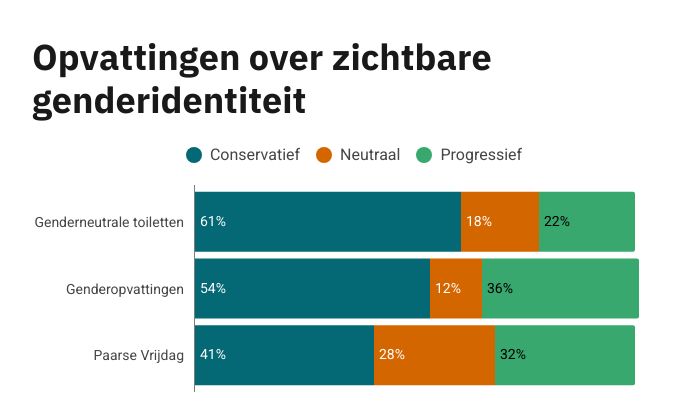
A majority of young people expressed more reserved views on the following concrete expressions of gender identity:
- 61% disagreed with the statement: “At least half of the toilets at school should be gender-neutral.”
- 54% agreed with the statement: “Whether you are a boy or a girl is fixed at birth.”
- On celebrating Purple Friday at all schools, 41% were opposed and 32% in favour.
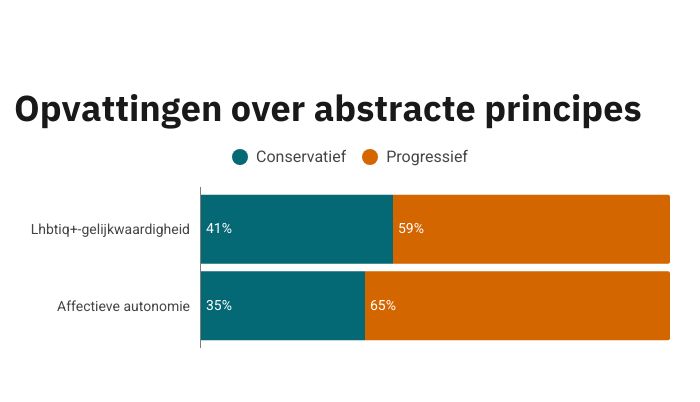
At the same time, a majority expressed agreement with more abstract principles:
- 59% believe that everyone is equal, regardless of whom you fall in love with.
- 65% believe that you should be free to decide for yourself whom you fall in love with.
Despite these majorities, the researchers describe the proportion of young people who do not endorse equality (41%) or personal autonomy in love (35%) as substantial.
What factors are associated with these views?
The researchers also examined which personal and social factors are associated with these attitudes. They found considerable variation between young people that cannot easily be explained by simple group characteristics:
- The strongest associations were found with general conservatism and gender: young people with more broadly conservative views also tend to hold more conservative views on LGBTIQ+ issues, and boys are on average more reserved than girls.
- Religion has a small to moderate effect. Religious young people, especially Muslim youth, on average hold more reserved views than non-religious youth: 86% of Muslim youth hold relatively conservative views, compared to 69% of Christian youth and 48% of non-religious youth.
- Differences between school tracks were statistically very small: students in vocational education (vmbo) are on average slightly more reserved than those in general or pre-university tracks (havo and vwo).
- Contrary to earlier research, no clear differences were found between young people with and without a migration background, nor between school years (and thus age groups).
Largely stable over time
Between 2021 and 2024, young people’s views show a slight shift towards more conservative responses, particularly among girls. However, the researchers emphasise that the effect is small, meaning that overall attitudes have remained largely stable.
According to the researchers, this is the first time these specific attitudes have been measured in this way. They recommend repeating such measurements and extending them to other age groups to better track and compare changes over time.
No uniform “Generation Z perspective”
The main conclusion is that there is no uniform “Generation Z perspective” on LGBTIQ+ issues. Young people display a wide spectrum of views, from relatively progressive to relatively conservative, and range from endorsing equality and personal autonomy to more reserved positions.
The researchers stress the importance of continuing to create space for dialogue between young people with differing views, encouraging interaction and nuance, and maintaining ongoing attention to gender diversity in schools and policy.
Reference
Dekker, N. P., Bakker, B. N., Munniksma, A., Daas, R., & van der Maas, H. L. J. (2026).'De lhbtiq+-opvattingen van jongeren: een empirische studie'. University of Amsterdam.