From speculation to science: Humans are born musical
10 March 2026
‘For much of the twentieth century, people thought studying the evolution of music was pure speculation,’ says Honing. ‘Because music can’t be found in the fossil record, many assumed we could never investigate it scientifically. But that view is now outdated.’
Babies show musical ability from birth
Some of the strongest evidence comes from infancy. Studies show that newborns can detect rhythmic patterns, prefer certain melodic contours, and form expectations about timing and pitch long before they acquire language.
‘These abilities emerge spontaneously,’ says Honing. ‘Infants respond to rhythm and melody without being taught. That strongly suggests we are born with biological predispositions for musical structure.’
‘These similarities are unlikely to be accidents,’ Honing says. ‘They point to shared cognitive biases – ways our brains naturally organise sound.’
Looking beyond humans
To trace musicality’s evolutionary roots, scientists also study other species. This comparative approach helps identify which components are ancient and which may be uniquely human.
Across cultures, children show an intuitive grasp of musical organisation, even in very different musical traditions. Although music varies widely worldwide, recurring patterns – such as common pitch relationships and rhythmic structures – appear consistently.
Recognising that musicality is a core biological capacity changes how we see ourselves. We are, by nature, musical beings.Prof. Henkjan Honing
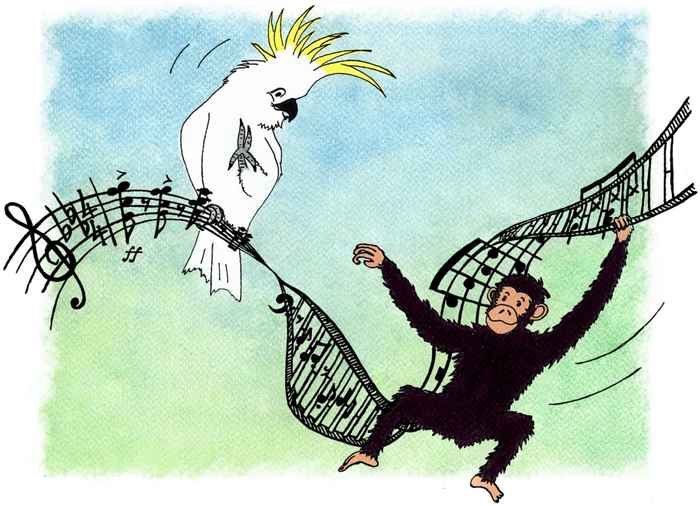
‘If a musical trait is found in humans and other primates, it likely existed in our common ancestor,’ Honing explains. ‘If we see similar traits in distantly related animals like birds, that suggests evolution arrived at similar solutions independently.’
Research supports what Honing calls a “multicomponent hypothesis”: musicality is not a single trait but a mosaic of abilities – including beat perception, pitch processing and emotional response – each with its own evolutionary history.
Not just language in disguise
For decades, many scientists assumed music was a by-product of language. Growing evidence challenges that idea. Brain imaging studies show that music and speech rely on partly distinct neural pathways. Some patients with severe language impairments retain musical abilities, while others with normal language experience congenital amusia.
‘Music is not just language with decoration,’ Honing says. ‘The evidence increasingly suggests that musicality is an ancient biological capacity, possibly predating language itself.’
Rather than evolving from scratch, musicality likely emerged by integrating older brain systems involved in perception, movement and emotion.
‘Musicality may have arisen by bringing together perceptual, motor and emotional building blocks in new ways,’ Honing explains.
Why it matters
The implications of this extend beyond explaining why we love music. Research on musicality may inform treatments for language disorders, motor impairments and emotional dysregulation, and may guide new approaches to education and well-being.
‘The study of musicality has moved from philosophical debate to empirical science,’ Honing says. ‘We can now ask precise questions about how specific components evolved and how they function across species.’
The growing evidence suggests that music is not merely a cultural ornament – it is a fundamental part of human nature.
‘Recognising that musicality is a core biological capacity changes how we see ourselves,’ Honing concludes. ‘We are, by nature, musical beings.’