Pride 2024: celebration of freedom or protest against inequality?
'Loud or Proud?' lecture by Anna Berbers
2 August 2024
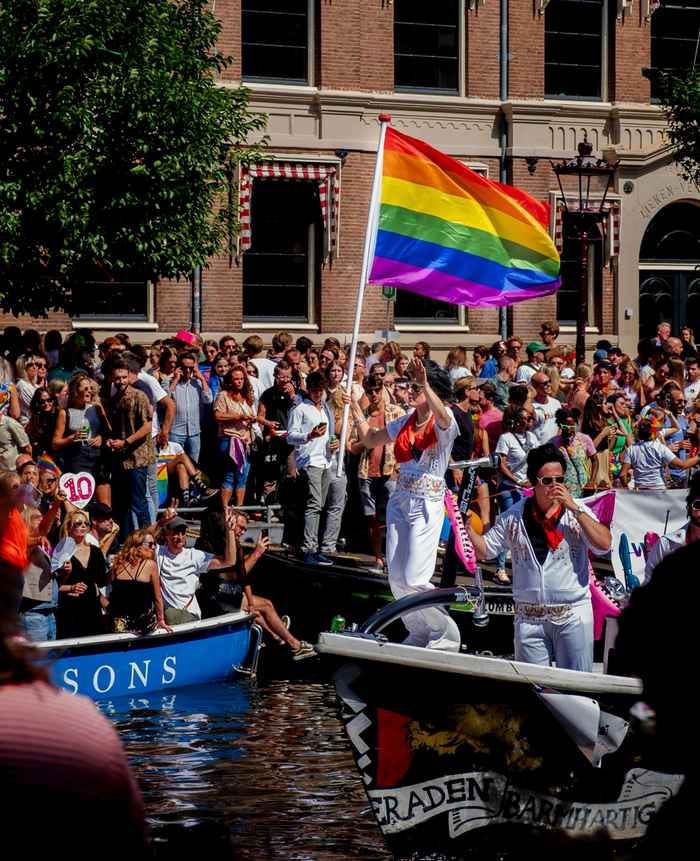
"Amsterdammers are loud," is the starting quote of Anna Berbers' lecture. Having grown up in the Dutch city, she experienced Pride for the first time at the age of 11. As a young ‘Amsterdammertje’ she felt the solidarity of the group and was proud that her city was showcased in this way. This early experience sparked her interest in the LGBTQIA+ community.
Eggs and maggots
Berbers first takes the audience through a brief history of Pride, with a special focus on the Netherlands. Roze Zaterdag (Pink Saturday) was inspired by events from the US, but in 1982 it ended in disaster when things went wrong in Amersfoort. The parade marching through Amersfoort was pelted with eggs and maggots. "Although it led to a bad day in Pride's history, this moment was a significant turning point in the celebration of homosexuality. The subsequent editions were well-coordinated by the government."
Over the years, different organisations have taken the lead in making Pride possible. Berbers provides an overview of the organisers and shows an interesting development. "Where Pride was initially organised by entrepreneurs of sex shops or gay bars, nowadays you see more and more large companies presenting themselves as sponsors."
Pinkwashing
This brings Berbers to the topic of pinkwashing, the strategy used by companies, organisations, or governments to appear as though they support the LGBTQIA+ community to gain a positive image or sell more products, while actually doing little to nothing to help or bring about real change. This is central to the main question of Berbers' current research: how has the meaning of Pride changed in the news over the years and how has the perception of pinkwashing evolved?
Establishment vs. Challengers
- Why is Pride important?
- For whom is Pride?
- How can organizations participate in Pride without engaging in pinkwashing?
Although the research is still ongoing, Berbers noted a clear difference in the meaning of Pride between the 'establishment' and the 'challengers.' The group belonging to the establishment sees Pride as a celebration of freedom and a party for everyone. Challengers believe that Pride is not only a celebration but also a protest for those whose voices are not heard enough. For them, Pride is a way to fight against the ongoing inequality and discrimination they experience as a group.
Pink King's Day
The lecture concluded with input from the audience, revealing divided opinions. Some saw Pride as an event where they "could be completely themselves, surrounded by friends and family," while others viewed Pride more as a "Pink King's Day where they felt increasingly unwelcome." This indicates that there is still room for improvement for the city of Amsterdam and Pride organisations. The final results of Anna Berbers' research will undoubtedly contribute to this.