Study programme
-
Year 1
In the first year, you build a foundation in key theories of Global Communication Science and learn to apply them to different cultures and current global issues. You develop research skills through courses in statistics, content analysis, surveys, and experiments.
In the second semester, you take two thematic courses: Media Innovations & Society and Crises & Resilience.
Throughout the year, the Skills Bootcamp helps you develop essential academic and professional skills for your studies and future career.
-
Year 2
In the second year, you deepen your knowledge of Communication Science through courses in quantitative and qualitative research methods and apply this in group projects. You also take the Communication Theme courses Marketing & Entertainment and Health & Sustainability.
In the second semester, you write an advisory report and complete an internship at an internationally oriented organisation in the Netherlands or abroad.
-
Year 3
In the third year, you shape your studies according to your interests. You can take elective courses, follow a minor, or study abroad on exchange, either deepening your knowledge of Global Communication Science or exploring other fields such as Business Administration or Sociology.
In the second semester, you conduct your own research project, applying what you have learned throughout the programme and presenting your findings to both academic and general audiences.
-
Introduction to Global Communication Science: Global and Comparative PerspectivesPeriod 1Period 2Period 312
In this course, you will explore key theories and developments in global communication science and learn how media influence people and societies. In addition, you will examine how these theories and concepts are similar or different across the world. You will also learn more about what makes 'good' and 'valid' research.
-
Communication Research 1: The BasicsPeriod 1Period 2Period 312
In this course, you will learn important research methods and statistical analyses. You will be introduced to various research designs, data collection, and data analysis. In addition to attending lectures, you will also participate in tutorial sessions where you will practice using the statistical software package SPSS.
-
Communication Theme 1: Media Innovations & SocietyPeriod 46
Learn about the changes of digital media production and usage across the globe. You will look at how algorithms and AI influence what we see and how they impact privacy and societies in different countries. You will also learn how global media laws regulate them. Through examples and guest lectures, you will analyse the power and ethical challenges of today's media landscape.
-
Communication Research 2: Content AnalysisPeriod 46
In this course, you will learn how to compare media content from different countries in a systematic way. We will cover various methods of content analysis and you will work on research projects both individually and in small groups.
-
Communication Theme 2: Crises & ResiliencePeriod 5Period 68
How do we tackle big challenges in today’s world? This course looks at global issues like crises, fake news, and polarization through the lens of communication. You will explore how these problems affect society, organisations, and individuals - and how communication can help solve them. Through lectures and group activities, you will learn about crisis communication, media literacy, and other solutions to build a more informed and resilient public.
-
Communication Research 3: Survey & ExperimentPeriod 5Period 68
Surveys and experiments are two research methods that may seem similar but answer different questions (like whether things are related to each other or if one thing causes another). In this course, you will explore their strengths and weaknesses through lectures, tutorials, and self-study. Most importantly, you will gain hands-on experience by working in teams to design and carry out your own survey and experiment.
-
Skills BootcampPeriod 1Period 2Period 3Period 4Period 5Period 68
This course helps you grow your confidence and develop the skills you need for an international study and work environment. You will improve your critical thinking and communication skills and learn to understand different cultural perspectives. Through interactive workshops and teamwork, you will practice how to build well-structured arguments, analyse complex texts and adapt your communication style to different contexts and cultures.
-
Communication Theme 3: Marketing & EntertainmentPeriod 16
In this course, you will explore how entertainment and persuasive communication work together to create effective marketing strategies. You will learn how to use media, influencers, and storytelling to engage audiences worldwide. By understanding global market differences and current trends like gamification and viral content, you will gain skills to develop marketing strategies that are both entertaining and impactful.
-
Communication Research 4: Statistical ReasoningPeriod 16
Deepen your statistical skills and gain a better understanding of data analysis. You will explore the principles of inferential statistics, including sampling, estimating population characteristics, testing null hypotheses, and test power. Additionally, you will learn how to apply various models using SPSS.
-
Communication Theme 4: Health & SustainabilityPeriod 26
Explore how health and sustainability problems are addressed by individuals, experts, organisations, politicians and journalists across different cultures. You will learn how to effectively communicate across borders for a healthier and more sustainable future, in a world that is becoming more divided.
-
Communication Research 5: Qualitative ApproachesPeriod 26
This course is about the fundamental principles of qualitative research in communication science. You will learn the qualitative techniques that are needed to conduct research in an international and intercultural context. You will learn about techniques such as in-depth interviews and focus groups, and develop skills for data collection and analysis. You will write your own qualitative research proposal and learn to critically evaluate the trustworthiness of your project.
-
Communication Science in Practice 1: Global Case StudiesPeriod 36
Learn how to apply communication theories to give advice on real-world situations around the world. You will develop skills to reflect on ethical issues and adapt your communication advice to different cultural contexts. You will work in groups and look at practical situations from different communication domains such as marketing, PR, internal communication, and political lobbying.
-
InternshipPeriod 4Period 524
During the internship, you will apply the knowledge and skills you have acquired during your studies in a practical setting at an international company or organisation. You will also gain new experiences that are relevant to your field of study. Additionally, you will conduct research as part of your internship and write a report on your findings.
-
Communication Science in Practice 2: The Internship CasePeriod 66
You will learn how to use your knowledge of communication science to give effective advice in a practical and professional setting, such as your internship. You will use an example from your internship and practice your skills in ethical decision-making and how to adjust your communication advice to challenges in an international context.
-
Elective spacePeriod 1Period 2Period 330
The elective space can be customized according to your preferences, allowing you to choose elective courses, a minor, or participate in an exchange programme abroad.
-
Communication TopicPeriod 46
This is an elective course related to communication science. You can choose from a list of elective courses, for example: Content Marketing, where you learn how companies develop their own content to attract a specific target audience or Sports and Communication, where you explore how sports messages are created, shared, and understood by society.
-
Communication Research ProjectPeriod 4Period 518
You combine all the knowledge you have gained over the past years and apply it to your own research. You show your ability to conduct independent and systematic research.
-
From Research to ImpactPeriod 66
In this course, you will learn how to turn your research results into something that different audiences and cultures can understand to make a real and lasting impact globally.
English or Dutch track?
You can choose between the English or Dutch track. In both, you study the core theories, but you apply them differently:
- Communicatiewetenschap focuses on communication in specific fields such as organisations & society, entertainment & media, political communication & journalism, and marketing & health communication.
- Global Communication Science emphasises international communication and communication challenges across cultures.
-
Internship
You will follow an internship at an organisation of your choice (with an international-oriented focus), gaining valuable work experience and applying your academic knowledge of global communication science in a professional setting. This is an excellent opportunity to develop practical skills, learn more, and enhance your resume. You can choose to do your internship in the Netherlands or abroad, broadening your horizons and expanding your global network. With support from an assigned supervisor, you'll make the most of this enriching experience.
-
Study abroad
The UvA has partnerships and exchange agreements with more than 100 universities worldwide. During your elective space, you can participate in an exchange semester abroad, offering a valuable learning and cultural experience that greatly enhances your study programme.
You can only go abroad in your third year, which means you'll use your elective space for an exchange semester.
-
Electives / minor
You have the option to select several courses yourself or pursue a minor. A minor is a cohesive six-month programme (30 ECTS) inside or outside of your main study area. It allows you to either deepen your understanding of a specific subject or broaden your knowledge. By doing a minor, you can explore new interests and develop skills in different fields. These are the most chosen minors by our students: Communication in the Digital Society, Business Administration: Managing Strategy and Marketing, Sociology, Amsterdam Data Science and Artificial Intelligence, and Mis- and Disinformation.
-
Career orientation and network opportunities
We organise numerous events and workshops featuring alumni, such as our annual speed dating event called ‘ComScience Kickstarter’. These activities provide excellent networking opportunities and allow you to gain valuable insights from experienced professionals.
-
Honours programme
Do you want more challenge during your studies? In the selective honours programme, you can take additional courses both within and outside your Bachelor's programme. This allows you to deepen and broaden your knowledge. The programme consists of 30 study credits and is completed alongside your regular coursework. Upon completion, you will receive an Honours certificate.

I am currently writing my thesis and next year I am planning to go abroad for one semester.Read how Armitha personalised her programme
-
Time distribution
You have a limited number of hours in lectures, with a strong emphasis from the first year on working on challenging assignments with fellow students in tutorial groups. On average, you will have 4 hours of lectures per week, 12-14 hours of tutorial groups and 25-30 hours of self-study.
-
Teaching methods
- Lectures: The lecturer explains the week's material to all students taking the course, and you have the opportunity to ask questions.
- Tutorial groups: You practice the material interactively in smaller groups, under the guidance of a lecturer.
- Guest lectures: A communication professional explains a real-life example of global communication science to give you more insight into the work field.
-
Tutoring
During your studies, you are supported in different ways. There is always a team of study advisers available if you have questions about your study planning or if you have difficult personal circumstances. You will also take the course Skills Bootcamp during the first two years of the Bachelor’s. During this course, you focus on improving your academic and practical study skills.

How do media effects on attitudes and behavior come about? And to what extent do we determine our media use and how media influence us?Dr. Annemarie van Oosten about the course Introduction to Communication Science, read more
-
What is the difference between Global Communication Science and the Dutch-taught Bachelor’s programme Communicatiewetenschap?
Global Communication Science is an English-taught track with a slightly different focus than the Dutch-taught Communication Science (Communicatiewetenschap) programme.
Both tracks cover the same core theories, but they differ in how these theories are applied. The Dutch-taught Communication Science track focuses on domains such as organisations & society, entertainment & media, politics & journalism, and marketing & health. Global Communication Science addresses similar themes but places stronger emphasis on international communication and communication across cultures.
Both programmes prepare you for a career in communication. However, the English-taught track may offer stronger connections to international Master’s programmes and global career opportunities.
In terms of quality, the programmes are the same. One is not better than the other, it depends on your interests and future plans.
-
What role does statistics play within the Bachelor's in Global Communication Science and can I prepare myself for it?
Statistics and research methods play an important role throughout the programme. You will start working with them from the very beginning of your studies.
In years 1 and 2, you will take several courses that teach you how to read, understand and conduct research. In year 3, you apply this knowledge during your thesis project and internship.
If you have a pre-university diploma (similar to the Dutch vwo-diploma), you are generally well prepared for these courses and can start directly with the first course, Methods of Communication Research and Statistics. Additional preparation is therefore usually not necessary.
By actively participating in UvA Matching, you can get a good impression of the programme and the role statistics plays in it.
-
What makes Global Communication Science at the UvA different from similar programmes at other universities?
Several things make this programme unique:
- Internship: This Bachelor’s includes an internship, which is not always a standard component of similar programmes at other universities. It allows you to apply your knowledge in practice and gain valuable work experience.
- Research and statistics: At the University of Amsterdam, you not only study the content and use of media and communication, but especially their effects on people and society. Measuring these effects requires scientific and statistical research, which is why research methods and statistics play an important role in the programme.
- Four specialised domains: During the programme, you explore four key domains: Media Innovations & Society, Crises & Resilience, Marketing & Entertainment, Health & Sustainability.
- Strong international focus: You study together with students from all over the world and apply communication science theories to global affairs.
This broad focus prepares you for careers in many different sectors, especially at international companies or organisations.
-
On which days will I have classes, and can I keep my part-time job?
You will receive your class schedule in the week before your studies begin. The exact days of your lectures and tutorials may vary from semester to semester.
On average, the programme requires 30 to 40 hours per week. This includes lectures and tutorials, as well as time for preparation and self-study, such as reading research articles or working on assignments.
Everyone experiences the workload differently, so whether you can combine your studies with a part-time job depends on your personal situation. Many students find that the first semester takes some time to adjust to the university environment, the teaching style and the pace of the programme. With the support provided through tutorials, guidance from the programme and sufficient self-study, most students are able to manage their studies successfully.
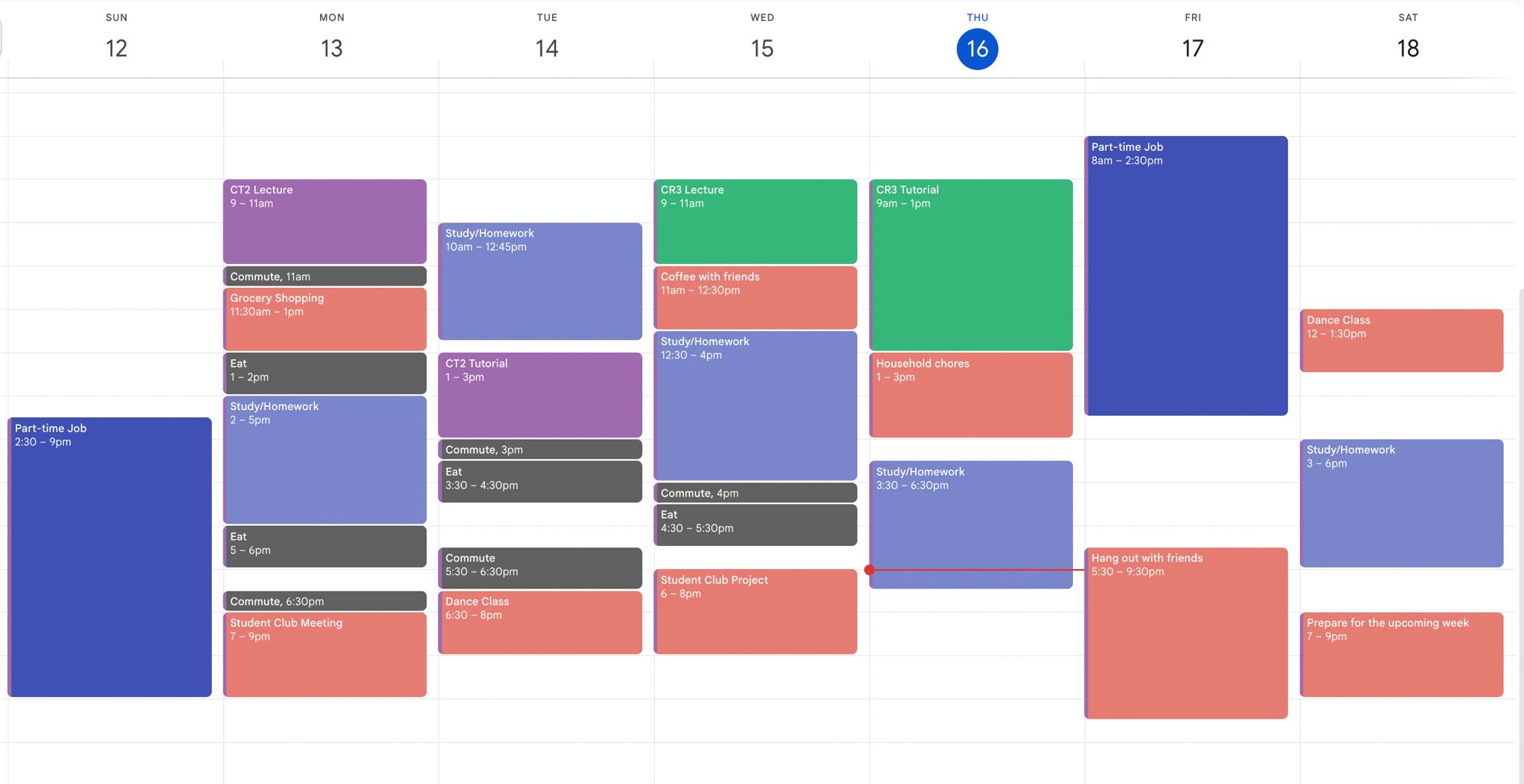
Here is an example of a first-year student’s week:
-
Is the programme very theoretical, or is there room for creativity?
Global Communication Science is an academic programme, so you will study many theories and conduct research. However, this can be surprisingly engaging and creative, because you work with real communication issues from everyday life.
For example, if you are interested in social media and trends, a course such as Media Innovations & Society might allow you to study how certain TikTok content influences young people across different cultures. You would analyse real posts, results and how audiences respond to them.
In many assignments, you can choose your own research topic, allowing you to explore subjects that match your interests, such as music, gaming or sports. You will learn how to formulate research questions, collect data and interpret results.
The programme does not include practical courses in creative skills such as filming or graphic design. For example, you will not be asked to create social media campaigns yourself. Instead, you will study the theoretical foundations behind successful global campaigns, advertisements and communication strategies.
If you are interested in developing creative skills alongside your studies, you can take courses at CREA, the cultural student centre of the University of Amsterdam. Each semester, CREA offers workshops and courses in music, dance, theatre, visual arts, writing and more. CREA also offers courses that complement Global Communication Science, such as video editing with Final Cut Pro X or image editing in Adobe Photoshop.
-
Can students from a university of applied sciences (hbo) start a Master’s in Communication Science directly?
You cannot directly enrol in the Master’s in Communication Science as a student from a university of applied science (hbo), Instead, you first complete part of our Dutch Bachelor’s programme Communicatiewetenschap, after which you can apply for a Master’s.
You can find more information about this pathway on the short-track Bachelor’s programme page (only in Dutch).