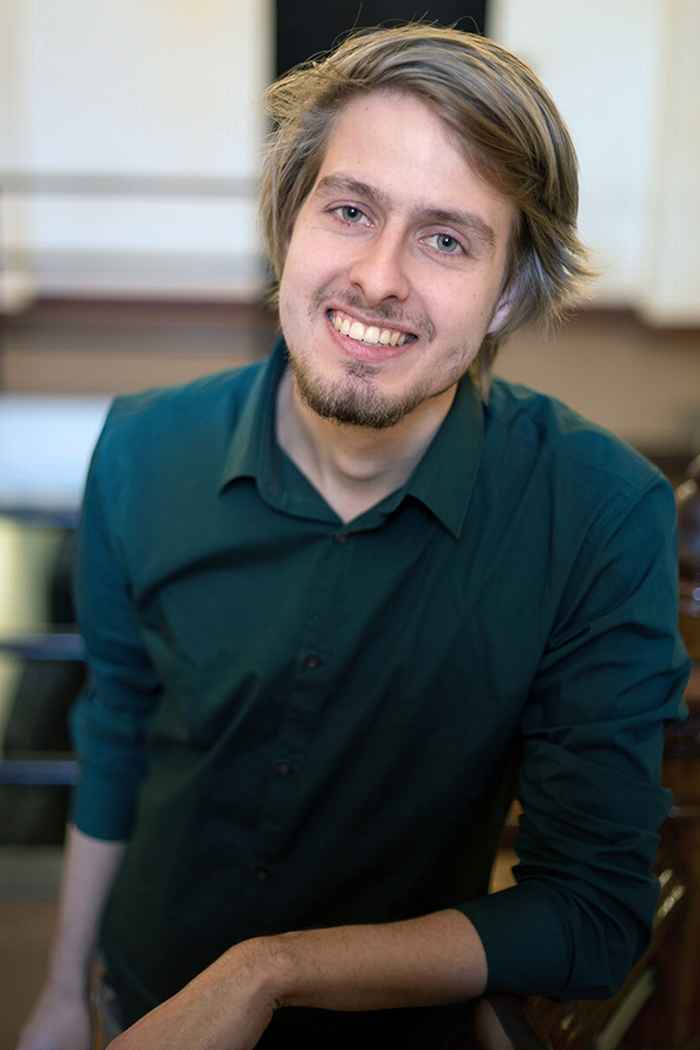
Rick Bleumink
What did you do before this?
Before this I did a Bachelor’s in History at VU University Amsterdam.
Why did you choose this Master’s programme?
I joined this Master’s because I’ve often travelled around eastern Europe. I’ve been there a lot. I wanted to learn more about it, but I couldn’t do that at the VU University Amsterdam. So I looked around to see where I could do it. That quickly led me to the University of Amsterdam (UvA). I noticed that the European studies curriculum included many different subject areas, all specialisms of the lecturers there. And I thought it looked really suitable for me. During my Bachelor’s in History at VU University Amsterdam I did a lot of architectural history. It was general art and architectural history, but I specialised in eastern Europe, particularly the architecture of eastern Europe. This included places like Warsaw and Riga, where wonderful examples of Stalinist architecture can be found such as the Seven Sisters, of which the largest is located in Moscow. I’m interested in all of that.
What is it about eastern European architecture that interests you so much?
It's totally unlike western European architecture. It’s relatively unfamiliar to us here, but in eastern Europe itself, its own architecture is a highly developed area of study. That is certainly the case for Russia. But at the same time, I think it’s interesting to look at the similarities and differences within eastern Europe. Poland and Lithuania, for example, have different architectural features in common than Russia and Lithuania. I'm interested in unpicking those similarities and differences.
Do you have any tips for students trying to choose a Master’s programme?
If you’re still looking for a Master’s programme, you can do the following. Go to the online course catalogue and just enter the subjects you're interested in. I entered words like Russian, Slavic, architecture and so on into the search box. And then see what subjects come up. If they’re close to what you’re looking for, research those subjects more thoroughly or email the study programme coordinator for more information. But be aware that what’s available now, might not still be there next year. And you have four electives in the year of this Master’s programme. So you really need to choose strategically.
Or conversely: think about where you want to end up. For example: if you want to work at the Ministry for Foreign Affairs, you can look at what they expect. What do you need to have? Which Master’s programme fits best with that? And if you’re interested in the Master’s in Eastern European Studies, look at the lecturers’ own subject areas. Micha Kemper, for examples, teaches ‘Political Islam’. That didn’t appeal to me at first, but I looked it up in the course catalogue. I saw that it covered the Caucasus, which I’m interested in.
What is your thesis going to be on?
Well, that’s a tricky one. First I want to do an internship abroad. So I’ve decided to write my thesis next year. I have enough time under the duration of my study programme to be able to do that.
Do you do things outside of your studies?
Yes, more than I can even really list here, but I’ve always been like that. At the moment I’m doing an internship at ARCAM, the Amsterdam architecture centre. I also go to a lot of lectures. I recently gave a lecture myself on the history and architecture of the Bijlmermeer. I travel a lot and organise trips for others. And I’m an active member of the Liber student association. It’s an inter-university association and organises lots of different things. I’m editor in chief of the Liber magazine and I give support to first-year students.
What do you see in your future?
As for where I’d like to end up – I’m really very interested in architecture. I’ve already been in touch with an organisation which works on urban development in the Romanian capital Bucharest. To be honest I don't know yet, but the mix of history, politics and architecture – which is actually the mix represented in my Master's – is what I'd like to pursue.