Study programme
Research is at the core of the programme. As you progress, you spend an increasing amount of time working within research groups and develop the knowledge and skills to conduct biomedical research more independently.
Your programme at a glance
All students begin with the compulsory 6 EC course Molecular Biology of the Cell, followed by 12 EC of track-specific courses. The remainder of your programme is largely shaped by your research interests and the profile you want to develop. Research projects can range from 30 to 60 EC, while the literature review accounts for 12 EC. You can also include elective courses or, depending on your chosen programme, a 60 EC major.
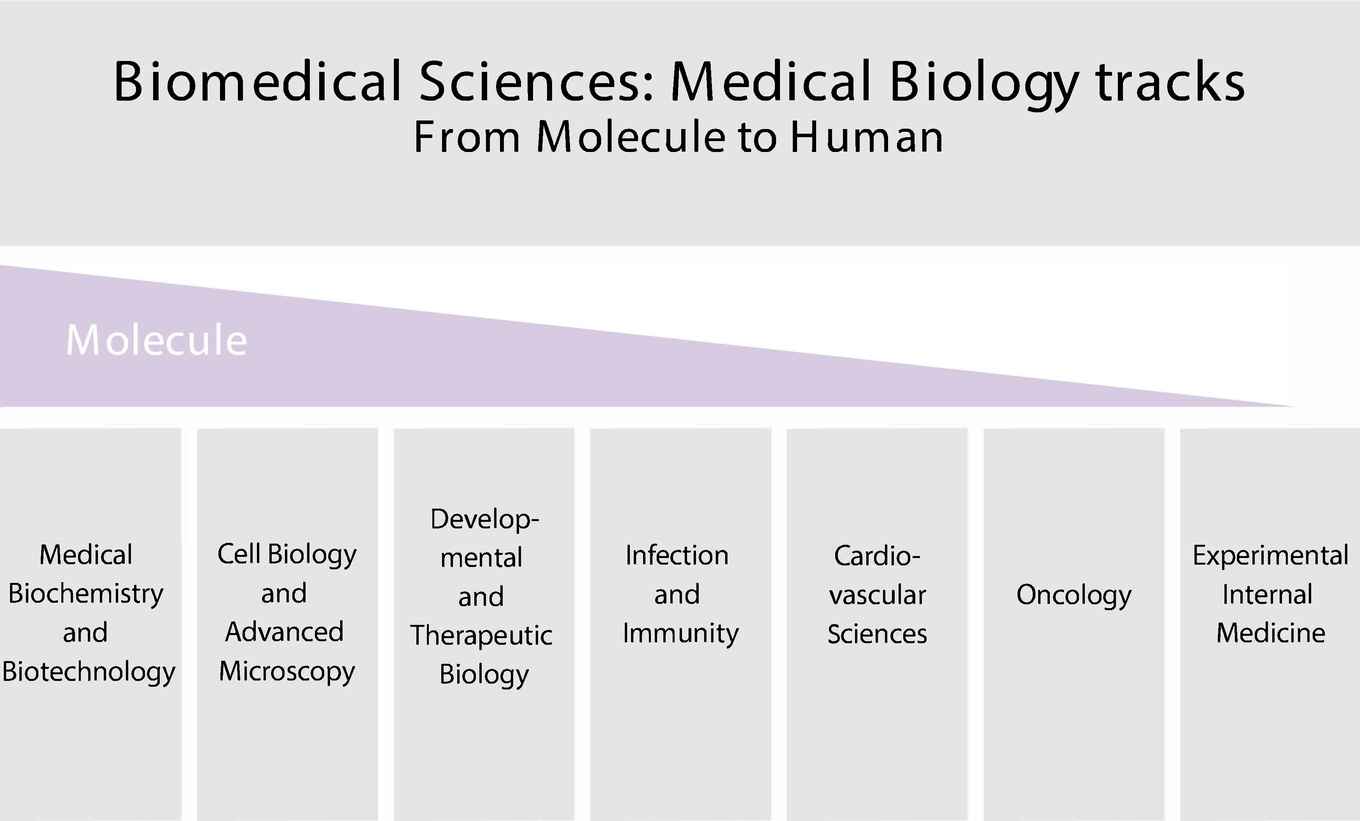
Seven tracks: from molecule to human
You choose one of seven tracks to give your MSc a scientific focus:
- Medical Biochemistry and Biotechnology
- Cell Biology and Advanced Microscopy
- Infection and Immunity
- Developmental and Therapeutic Biology
- Experimental Internal Medicine
- Oncology
- Cardiovascular Sciences
Together, the tracks cover the molecular and cellular processes important in human health and disease. The tracks provide direction rather than rigid boundaries: the fields overlap, and your track does not necessarily restrict the research projects you can pursue. You shape your programme in consultation with your track coordinator.
Research is the core of your master programme
Your research projects are where you put your scientific knowledge into practice. You join a research group and work on pioneering biomedical research question under the supervision of experienced scientists. These research internships form a substantial part of the programme and give you the time to become fully involved in a research group.
Rather than completing short practical assignments, you work on substantial scientific questions and take increasing responsibility for designing your research, analysing results and communicating your findings. Depending on your project, you may work in a laboratory experiments, use computational methods, or variations thereof.
Research projects can take place at the UvA and affiliated research institutes, elsewhere in the Netherlands or abroad. Almost half of Medical Biology students complete a research project abroad. Around half of students become co-authors of a scientific paper, indicating the quality of the research projects. making the research projects particularly valuable preparation for a PhD or other research career.
Learn within Amsterdam's biomedical research network
Medical Biology brings together expertise from the Swammerdam Institute for Life Sciences (SILS), Amsterdam UMC, the Netherlands Cancer Institute (NKI) and Sanquin. This gives you access to a broad range of biomedical research environments, from fundamental molecular and cell biology to research closely connected to human health and disease.
Researchers from these institutes are closely involved in the programme as lecturers and supervisors. The involvement of these institutes provides a wide range of possibilities for your research projects.
Further shape your programme through electives
Beyond your subject-specific training, you can use electives to broaden your knowledge and develop skills that complement your research profile. Your choices allow you to shape the programme around your interests.
Major: Big Biomedical Data Analysis
If you wish to specialise in the computational approach, the Big Biomedical Data Analysis (BBDA) major is a 60 EC programme available for students from all tracks. It combines biomedical science with bioinformatics and trains you to analyse and interpret large-scale omics data.
The major includes courses in genomics, transcriptomics, proteomics and metabolomics and a 42 EC research internship. It is particularly suited to students who want to combine experimental biomedical research with computational data analysis.
Michelle Smulders, Master's student in Biomedical Sciences, explains why she chose the Big Biomedical Data Analysis Major and tells you more about the study programme.
Major Teaching
Want to use your scientific expertise in education? With the 60 EC Major Teaching, you can dedicate the second year of your MSc to training as a qualified teacher. The major combines your biomedical background with didactics, educational theory and practical teaching experience. It is a good option if you enjoy explaining science, working with students and translating complex biological concepts into engaging education. The Major Teaching is taught in Dutch.
Double degree in Medicine and Biomedical Sciences
Selected students can combine Biomedical Sciences with Medicine in a three-year double Master's programme. This route is only available for students with a bachelor in Medicine from the UvA and a suitable Biomedical Science bachelor degree.
Accreditation and academic title
The Medical Biology tracks are part of the accredited Master's programme in Biomedical Sciences. After successfully completing the programme, you receive a legally accredited Master's degree in Biomedical Sciences and the title Master of Science (MSc). The Biomedical Sciences Master's received a positive outcome on its 2023 reaccreditation.
Bring your own device
Because of the nature of the programme, all Biomedical Sciences students are expected to bring their own laptop. Specific system requirements are available on the UvA student website.