Scientific Programming in Python I
Python is one of the most widely used programming languages in the world. Scientific Programming in Python I is designed for professionals who want to learn the fundamentals of programming in a scientific context. In this 7-week course, you will build a solid foundation in Python and learn how to write, understand, and apply basic code to solve scientific problems.
Python: an ideal programming language
Flexible set-up with extensive support
Unique course structure
Learn Python in a scientific context
For whom?
Scientific Programming in Python I is designed for beginners with little to no programming experience. This course is suitable for anyone who wants to learn programming in Python and has an interest in scientific applications, such as data analysis or natural language processing.
A university or higher education level is recommended.
Course description
Python is used for many different applications such as web development, data science and machine learning. This Scientific Programming in Python I course serves as an excellent entry point for mastering the essential principles of programming in Python over a span of 7 weeks. During this 7 week course we focus on the basics of programming, which you will learn by working on programming problems from several scientific areas. After completing the course you will know the principles of programming, be able to apply them to any domain and use them for your own projects.
Already have programming experience?
If you already have some programming experience our follow-up course Scientific Programming in Python II might be a better fit for you. If you are unsure whether you are ready for the second course, you can take the self-assessment. It gives you an indication of your current level and whether you are prepared for more advanced topics and problem-solving. The assessment includes example problems that reflect the expected starting level of Scientific Programming in Python II. If you can solve them independently, you are ready to start with Scientific Programming II and you can skip part I.
-
Flexible design
The Scientific Programming in Python 1 course is primarily self-study. Programming is best learned by doing rather than by listening to lectures. For this reason, the course does not include traditional lectures. Instead, learning is structured supported through a structured combination of independent study and weekly on-site tutorials.
The course consists of three levels and a bonus level. For the first two levels you can choose between two different modules (this is not applicable for the third level). This allows you to choose the module that fits your interests best.
The total amount of expected hours is 80 hours over the course of 7 weeks. This means that the time investment will average to a little over 11 hours per week.
The course concludes with an on-site final exam at an UvA location in Amsterdam. There are two exam opportunities: the final exam and a resit (approximately two months later) if you did not pass the final exam.
We really encourage you to complete each course within 7 weeks, but if you are not able to finish it in 7 weeks you are able to continue with the course, finish your assignments and join the tutorials to get assistance until the next exam date (resit). -
On-site tutorials
On-site tutorials are a core part of the course. During these sessions, you work on your assignments and receive support from lecturers when needed.
You are expected to attend at least three tutorials during the course (attendance is recorded). To get the most out of the course, we strongly recommend attending weekly.
Participants who attend tutorials regularly are significantly more likely to complete the course successfully. These sessions help you stay on track, overcome difficulties early, and deepen your understanding of the material.
Weekly on-site tutorials at Science Park campus:
You can choose a time slot that fits your schedule
• Mondays 13:00–16:45
• Wednesdays 13:00–16:45
• Fridays 15:00–18:45 -
Modules
Level 1 (you can choose one of the modules)
ALGORITHMS. Learn to think like a computer. Things that we intuitively know how to do, like drawing a pyramid or computing change for a payment, is hard to get a computer to do right. In this module you’ll learn how to break down such intuitive problems into steps that even a computer can understand. or NUMBERS. How do you know if a number is a prime number? Number theory is the science about properties of numbers. In this mathematically oriented module you create a series of programs that compute this and other properties of numbers. No math knowledge required for this module. (You will learn some, though) Level 2 (you can choose one of the modules)
TEXT. Natural language processing is the science of making a computer understand (something about) natural human language. You will learn how you can get a computer to understand the sentiment of tweets. Is the tone of the tweet positive or negative?
or NUMERICAL INTEGRATION. In many scientific fields you need to determine the surface area under a function. Integration is a mathematical tool for doing so. However this tool doesn't always work and in such cases we can use numerical integration techniques to let the computer do the work for us. You will learn two important techniques for numerical integration. Level 3 (there is no choice for this level) BIG-DATA. In this module you will learn to work with data. You will, for example, analyze weather from the Netherlands and answer questions like: When was the first heat-wave? What was the longest freezing period? Bonus level (this module is optional) MOVEMENT. What happens if you dig a tunnel from one side to the other side of the planet and you fall in this tunnel? In this module you’re going to simulate that situation. In physics you often run into problems that are too laborious to compute by hand. In this module you’ll learn how to use your computer instead. -
After completing the course
- You can transform the description of a simple algorithm into working code by combining basic programme elements.
- You can track down and fix several common programming errors in simple programmes.
- You can apply several scientific programming techniques from different fields of study.
- You can make your programmes simple to understand and easy to read by employing standard tactics.
- You can use libraries in your programme and know how to find and read documentation on new-found libraries.
-
Course materials & laptop
All the reading and video material is available on the website of the courses. You do not need to purchase any books or software. You will get access (on the day of the kick-off) to the programming modules online. Every module consists of short explanations (written and in the form of videos) and assignments.
Laptop
For these courses you need to have your own laptop (for the kick-off day and the tutorials on which the software can be installed. We are not able to provide you with a laptop.
-
Schedule 2026-2027
Kick-off: Wednesday 7 October 2026, 10:00–15:30
LAB42, Amsterdam Science ParkExam: Tuesday 15 December 2026 09:00-11:00
REC D4.02 (Brug), Roeterseiland Campus, 1018 WS AmsterdamResit: Date: to be announced
Location: AmsterdamKick-off:
Wednesday 3 March 2027
Lab42, Amsterdam Science ParkExam: Date: to be announced
Location: AmsterdamResit: Date: to be announced
Location: Amsterdam
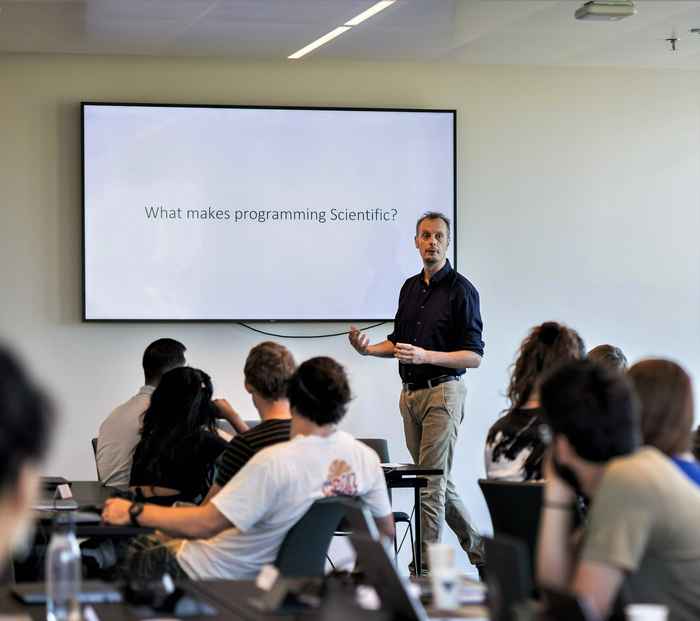
The course starts with a kick-off which will take place on our UvA Science Park campus. The goal is to get started with the course, get an overview of the topics that will be discussed and to meet fellow participants.
Kick-off Scientific Programming in Python I:
• Wednesday 7 October 2026, 10:00–15:30
• Wednesday 3 March 2027, 10:00–15:30
Exam and certificate
Every module has an assignment which needs to be completed successfully to pass the course. If your assignment does not get a passing grade you will always be able to revise and resubmit the assignment. The courses conclude with a final exam which takes place at the Science Park campus. There are two exam opportunities, the final exam and a final resit (about two months later). In the meantime, you can still join the tutorials to get assistance.
After completing the modules successfully and passing the final exam you will receive a certificate from the University of Amsterdam which states you have succesfully completed the course.
Get a microcredential for the course!
As of September 2024, both Scientific Programming in Python I and II are part of the national pilot Microcredentials which means you can obtain a digital certificate in the form of a microcredential after you successfully completed one of these courses. This recognized credential gives value to individual education units, by guaranteeing the quality of the course, and therefore allows professionals to demonstrate acquired knowledge and skills to (future) employers or other educational institutions. More info information about microcredentials can be found here.
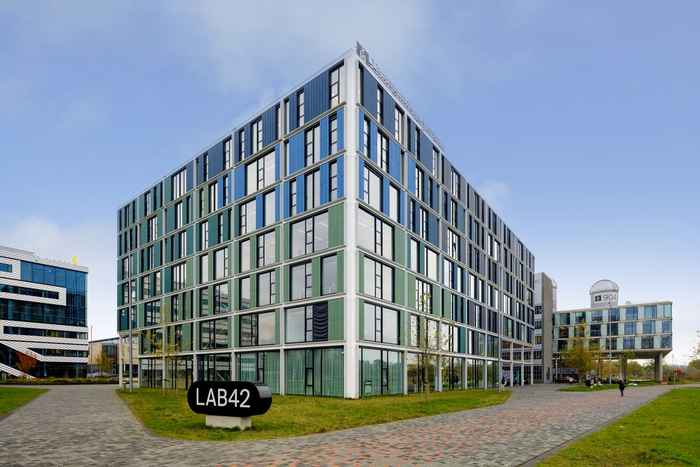
Both the kick-off and tutorials take place at Amsterdam Science Park in LAB42, an international hub for knowledge and talent development in digital innovation and AI. LAB42 is a vibrant space where AI researchers, computer scientists, students, and entrepreneurs come together to explore and advance the possibilities of artificial intelligence.
Contact
Do you have questions about this course? Please contact our professional education team:
E: professionaleducation-ivi@uva.nl