Jeen Engelenburg
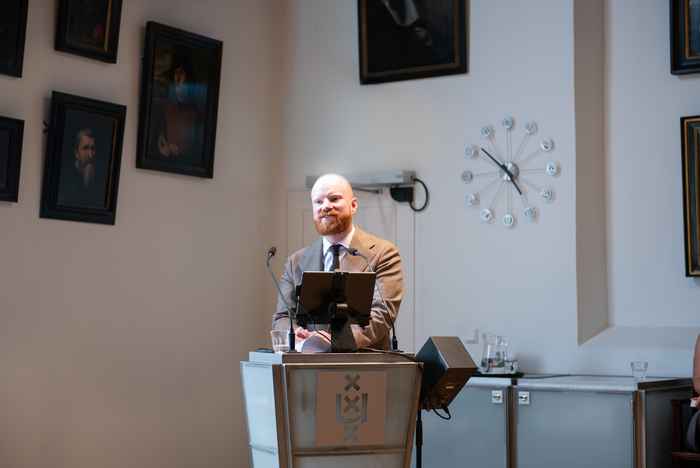
Why did you choose this programme at the time? Why did you choose the UvA?
During my Bachelor’s, I was introduced to the translational aspects of neurobiology, which I found extremely interesting. The PPP track is a research-oriented Master’s that provides a broad foundation for different areas of translational neurobiological research, so for me the choice was an easy one.
The UvA also has a strong profile in neurobiology that fitted well with my existing background. Another advantage is that there are many excellent research institutes in and around Amsterdam where students can complete research internships.
How much freedom did you have when selecting courses or projects? Are there opportunities to tailor the programme to your interests?
A large part of the Master’s consists of internships, which you can shape entirely according to your own interests. Alongside a number of compulsory courses, there is also plenty of room within the curriculum to choose your own direction.
For example, I completed the Big Biomedical Data Analysis major, which teaches biomedical scientists how to work independently with large datasets. This is becoming increasingly important in research, and it is a skill I now use every day in my postdoctoral work. In principle, you can really carve out your own path within the programme.
How practical or theoretical is the programme?
Because of the strong focus on research internships and the literature thesis, the programme is very practical. At the same time, you are well prepared for that practical work: before starting your internships, the advanced courses provide a strong theoretical foundation.
How would you describe the atmosphere within the programme? Do you interact a lot with fellow students and lecturers? Are there many group assignments, or is the focus more on individual work?
The atmosphere was very good, and I had a lot of contact with fellow students. Those connections can remain valuable later in your scientific career, if you choose to pursue one, because many of your fellow students are likely to follow a similar path.
The many guest lecturers are another strong aspect of the programme. You meet researchers working across very different areas of translational neurobiology. This helps you build your network and can also make it easier to find an internship that genuinely matches your interests.
What types of thesis or graduation projects are possible? Can you provide an example of your own project?
Almost anything is possible. I deliberately chose to do two very different types of internships.
For my first internship, I worked on a molecular biology project in the lab, carrying out classical knockdown experiments. My second project focused instead on analysing a complex gene expression dataset. That combination of wet-lab research and data analysis is exactly what I continued to do during my PhD and what I still do now as a postdoctoral researcher.
Was it easy for you to find a job after your Master’s? How did you end up in your current workplace?
In my case, things moved relatively quickly: one month after completing my thesis, I started my PhD.
I got there by contacting a professor with whom I had previously completed a Bachelor’s internship and whose research I found particularly interesting and relevant. As it happened, there was a vacancy at that time that matched the profile I had developed during my Master’s. After going through the application process, I was offered the position.
It shows how valuable the contacts you build during your studies and internships can ultimately be.
What advice would you give to someone considering this Master’s programme?
Do not treat your education as something you simply consume; take an active role in the courses and research projects you pursue. Ask guest lecturers questions, reach out to research groups that interest you and choose your internships based on those interests.
During this Master’s, you can begin to shape your own scientific profile, whether you go on to pursue a PhD or have a different career path in mind.