Study programme
Tracks
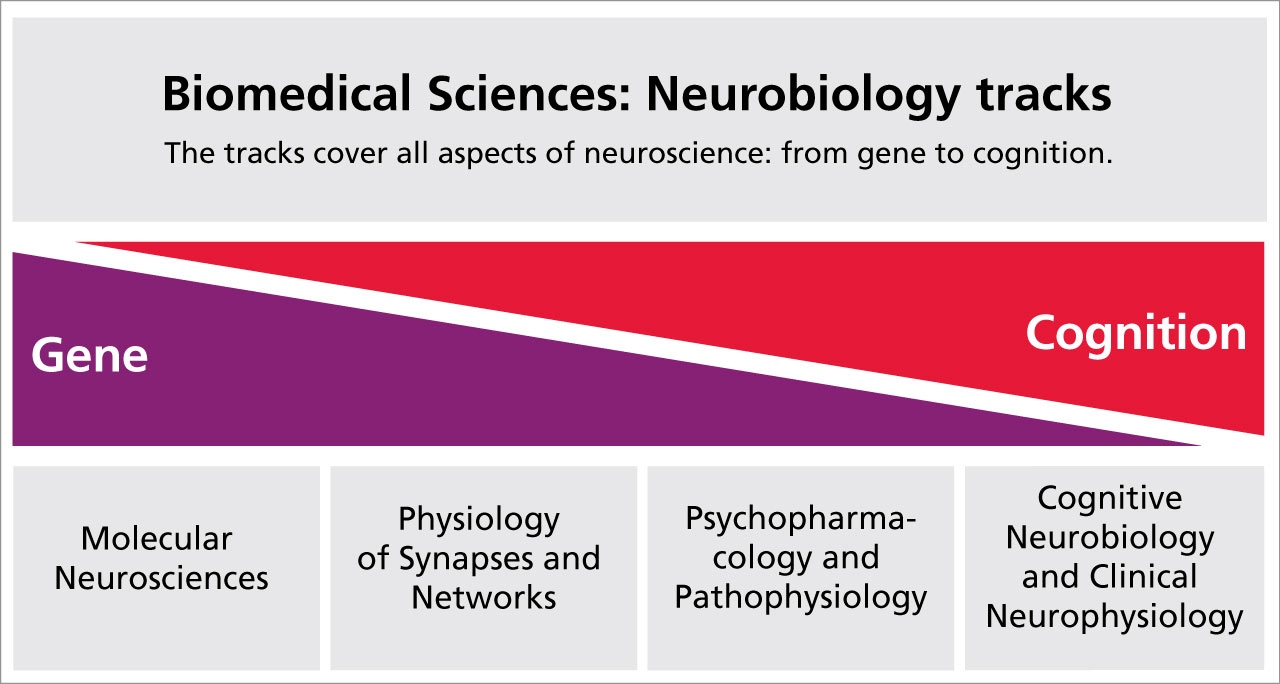
The Master's programme in Biomedical Sciences is a two-year programme of 120 EC in total. Your study programme largely depends on the track you choose. Within the neurobiological cluster there are four tracks, focusing on important fields within the larger scope of neuroscience. The picture below illustrates the scope of the four tracks: from genes to cognition.
Which track matches your interests?
The four Neurobiology tracks study the brain at different - but connected- levels, together spanning multiple levels of brain organisation, from gene to cognition. The main difference lies in the scientific questions, level of analysis and research methods emphasised by each track.
Molecular Neurosciences
Study the molecular and cellular mechanisms underlying brain development, function and disease. This track has the strongest focus on genes, signalling pathways, cells and laboratory-based molecular research.
Physiology of Synapses and Networks
Explore how neurons and synapses communicate, how neural networks process information and how these processes shape learning, memory and behaviour. Methods include electrophysiology, imaging and optogenetics.
Psychopharmacology and Pathophysiology
Investigate the biological mechanisms underlying neurological and psychiatric disorders. This track connects brain pathology, experimental disease models and neuroscience methods with pharmacological research and drug development.
Cognitive Neurobiology and Clinical Neurophysiology
Study how neuronal activity and brain systems give rise to cognition and behaviour - and how these processes are disrupted in brain disorders. The track combines direct measurements of neural activity with advanced computational neuroscience methods and quantitative analysis to understand how brain systems support cognition how these processes are altered in neurological and psychiatric disorders.
First year
In the first year, all tracks start off with an advanced eight week compulsory course in the specific area of interest followed by an optional course elaborating on the subject (See the information pages per track for more information). Furthermore, every student has to write an academic thesis and do at least one research project of 30 EC. In the third period a number of courses focusing on research skills will be offered.
Second year
In the second year, the student has a number of options: students may opt to take on additional courses, for example from another track, or choose to focus more on research by taking on a larger research project.
For detailed information regarding the curriculum and courses, please see the UvA Course Catalogue via the link below.
Major: Big Biomedical Data Analysis
Within Biomedical Sciences it is possible to follow a 60 EC major called Big Biomedical Data Analysis (BBDA) within all tracks. This one year programme is developed to teach biomedical students the essential bioinformatics to be able to handle, analyse and interpret big omics data sets. The major consists of courses on Genomics, Transcriptomics, Proteomics and Metabolomics, plus a 42EC internship.
Michelle Smulders, Master's student in Biomedical Sciences, explains why she chose the Big Biomedical Data Analysis Major and tells you more about the study programme.
Double degree Medicine and Biomedical Sciences
Students that have completed the double Bachelor's degree programme in Medicine and Biomedical Sciences or students that have completed a Bachelor's in Medicine and Biomedical Sciences can enrol in the double Master's degree programme in Medicine and Biomedical Sciences.
Accreditation and academic title
Degree requirements
A Master of Science in Biomedical Sciences is awarded upon successful completion of all the core courses in the curriculum, a written literature thesis and two independent research projects. This translates into a total of 120 EC credits.
Degree certificate
Neurobiology is a cluster of the accredited degree programme Biomedical Sciences. After successful completion of this programme, you will receive a legally accredited Master's degree in Biomedical Sciences and the title Master of Science (MSc).
Accreditation
The Master's programme in Biomedical Sciences has been legally accredited by the Accreditation Organisation of the Netherlands and Flanders (NVAO). This means that upon successful completion of the programme, students will receive a legally accredited Master's degree in Biomedical Sciences and the title of Master of Science (MSc).
In 2018 the Master's programmes in Biomedical Sciences at the University of Amsterdam received a final rating of "Good" in the reaccreditation recently concluded by the NVAO. This rating means the programmes 'consistently surpass the standard quality level'.
Bring your own device
All students enrolled in Biomedical Sciences are requested to bring their own laptop, due to the nature of the programme. More information on specific system requirements can be found here.