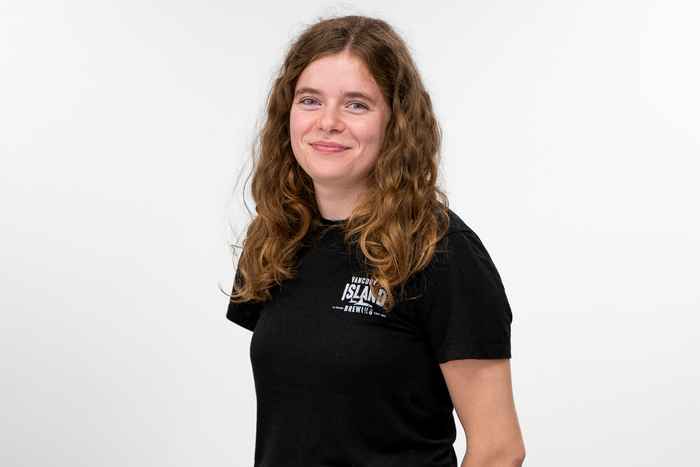
Susan van den Broek
Graduate Software Engineering
Why did you choose this programme?
“I took the minor in Programming at the UvA during my Bachelor Business Administration. I really liked it at the time: in my Bachelor's I often found it to be all just thin air, whereas in this minor I was really working on something tangible. When you are programming, you get immediate feedback on what you are doing. There is clear input and output. I found that very nice to work with.
After my Bachelor's, I decided not to move straight on to the Master's; I hadn't finished studying yet. I spent a year taking subjects I like (a mix of history and information science), and then I started working for a year. The idea was to gain work experience in the direction of the Master's I wanted to pursue in Business Administration. I noticed during that work that I got the most energy from the projects related to data and IT. As a result, I eventually decided to look for a Master's programme in that area.”
Why did you choose the University of Amsterdam?
“I wanted to stay within the UvA. I had spent my entire study career there so far, and it seemed a nice idea to keep a bit of stability. After all, I was going to pursue a completely different field of study for my Master's.”
How much freedom did you have when selecting courses or projects?
“As far as I know, the Master's curriculum is completely fixed. The only choice you have to make is what you want to write your thesis on. However, sometimes you can choose between different assignments within a course. This way, you can adapt the programme to your own interests.”
How practical or theoretical is the programme?
“In the programme it is assumed that you can already do programming. So you are not taught this practical skill. However, there are many practical assignments where you will need your programming skills. It is a one-year programme, which generally means there is less focus on research compared to the two-year research masters, However, it was very clear that the Software Engineering Master's does its best to train students academically. There is a lot of focus on professional literature, both reading and writing.”
How would you describe the atmosphere within the programme?
“The atmosphere within the master is very good. Activities are organised to get to know each other (both students and lecturers) outside the lecture halls. In my year, we spent quite a few hours with lecturers at Oerknal (campus cafe). After our last exam, we had drinks with everyone until the late hours. There is also an open atmosphere during lectures. Asking questions is not a problem, and people are very willing to help each other. Many subjects have group work. That way, you also get to know each other better. Besides group work, every course also has at least one individual component. This can be an exam, but also assignments you have to hand in every week. A course often has one big project, which consists of group work. That is also nice, because that way you can make use of everyone's individual qualities and strengths.”
What kind of thesis or graduation projects are possible?
“I wrote my thesis at a company. I wanted to do that because I wanted to get an early glimpse of the working field. I had already decided not to do a PhD. Because I wrote my thesis at a company, I had two supervisors: a day-to-day supervisor from the company, and an academic supervisor from the UvA. As my ambition was to graduate cum laude, together we tried to publish my work. We succeeded in this too! I went to a conference in Vienna to present my thesis there. That was a very nice experience, which would not have been possible without help from the UvA and the company.”
Was it easy for you to find a job after your master's? How did you end up at your job?
“After my studies, I started working for the company where I had also written my thesis. So I actually had a job right away. I really liked this, because I already knew the people and the product, so I could fully focus on putting my software engineering skills into practice.”
What advice would you give to someone considering this Master’s programme?
“I think you have to check mainly with yourself what you are looking for in a Master's degree. If you are more into the theoretical foundations of computer science, a two-year research master might be more for you. If your passion lies in doing, but at the same time you are not afraid of solid academic literature, then I would definitely apply for the Software Engineering programme. I personally experienced it as a very educational and, above all, enjoyable year.”