'Even in the age of AI, the best ideas still arise between people'
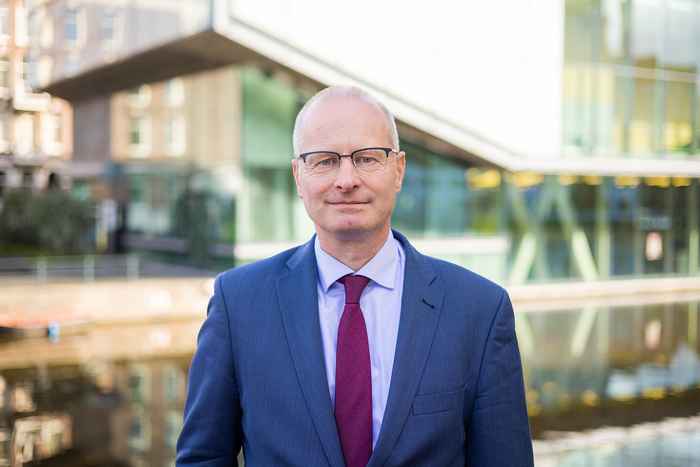
In an age of uncertainty and sweeping change, it can sometimes help to focus on what does not change. Such an analysis offers a way forward. That is precisely why, in an interview about the plans of UvA Economics and Business, Beetsma explains how historical patterns surrounding technology still apply today. He refers, among other things, to the success of the Ford Model T, the iconic automobile that was the first to be produced in large quantities.
From the Ford Model T to AI
'The success of the Ford Model T did not stem from superior technology. It became a success because a good production process was invented for it. And that is essentially how it always works: new technology only really takes off when it is adopted by people and organisations. We see that pattern in almost all major technological transformations, from the construction of railways to the rise of the internet. And I am convinced that we are seeing the same pattern now with the rise of AI.'
At first glance, AI adoption appears to be happening at great speed. A large share of humanity has embraced AI as a better search engine, a smarter assistant or a writing aid. But that is only the beginning, Beetsma says: 'The transformative value of AI as a general-purpose technology does not lie in what an individual does with it. The real value lies in designing new ways of working and organising. That is really the next phase, and that phase has only just begun. Our task as a university is to help create the right conditions for it and to help build the future of the Netherlands.'
Draghi and Wennink
Beetsma is not alone in this analysis. The well-known reports by Draghi, on the future of Europe’s earning power, and Wennink, on the future of the Netherlands, also leave no room for doubt that AI is a general-purpose technology that is essential to preserving, and preferably increasing, our prosperity. 'But that will not happen by itself. Yes, we need things like AI factories and startup ecosystems. But at least as important is educating people who know how to get the AI transformation moving within their company or sector. And particularly for a technology such as AI, that requires close collaboration between business, government and academia.'
Critical thinking
It is precisely in this area that UvA Economics and Business intends to make its presence felt very clearly in the coming years. Beetsma is aware that there is no simple recipe for success in this next phase. 'Of course we do not have all the answers as to how leaders in business and government should approach the AI transformation. But there are a number of things we do know. First, this transformation calls for different competencies. The ability to work with AI is therefore receiving increasing attention in our programmes. And by that I do not just mean writing prompts. It is about understanding what such systems do, what they do not do, and when you can or cannot trust their outputs.'
'That is also one of our faculty’s strengths. We have a long tradition in advanced analytics, from econometrics, actuarial science and operations research to data science and AI, and we connect that knowledge to applications in business and policy. As a result, students here learn not only how to work with AI, but also how to take a critical view of the output, the underlying assumptions and the consequences for decisions. That critical capacity will only become more important. After all, you can only judge critically if you understand how economic models, management concepts and organisational systems work. That knowledge is not becoming redundant. On the contrary: if AI takes over parts of the execution, conceptual understanding becomes more valuable.'
This development affects not only the content of education, but also the way students learn. Beetsma points to the experience gained with experiential learning, including in the AI4Business Lab. There, students work on real AI and data challenges put forward by companies and other organisations. They develop solutions and working prototypes for better administrative processes, smarter planning, more effective internal communication and decisions grounded in stronger evidence.
'Students do not just read about reality; they immerse themselves in it and use real business and societal challenges as study material. Collaboration is a didactic principle in that process. After all, you do not learn the best ideas from a book. They arise through interaction between people. Sometimes entirely by chance. But you can give chance a helping hand by creating the right conditions. We already have considerable experience with real world challenges, and we are now going to scale that up significantly.'
Research in practice
In research, too, UvA Economics and Business is explicitly seeking collaboration with organisations beyond academia. “Especially with AI, science and practice need to be closely connected,” says Beetsma. In his view, relevant research does not always begin with an abstract research question, but often with an urgent problem within an organisation or in society. When a new technology such as AI is applied in real processes, it becomes clear where the friction lies and which new questions arise as a result. The implementation of AI is therefore not the final stage of science, but its starting point. “That is precisely where you see relevant research questions emerging,” says Beetsma.
One example is ZODIAC. In this project, researchers from Economics and Business, together with colleagues from other UvA faculties and partners such as the Ministry of the Interior and Kingdom Relations and KPMG, are investigating what happens when AI systems perform tasks increasingly autonomously, support or take over decisions, and influence collaboration within organisations. The results should provide practical guidance for organisations that want to work responsibly with teams of autonomous AI agents.
An ecosystem for AI adoption
According to Beetsma, experiential learning and research with practice partners offer multiple benefits. Students develop competencies that are better aligned with what employers need. At the same time, stronger relationships with practice partners create greater synergy between science and society.
UvA Economics and Business aims to become the natural partner for organisations that want to experiment with, innovate with or transform through AI. Beetsma: 'Our position is extremely strong. We have a faculty with substantial academic firepower. At the Roeterseiland Campus, we are close to other social sciences, law and behavioural disciplines. In addition, we have Amsterdam Science Park with leading expertise in advanced technology, a city with international appeal and an already extensive network of collaborations with multinationals as well as SMEs. With our plans for the coming years, that ecosystem will gain enormous strength.'
Read more about how UvA Economics and Business collaborates with organisations on AI adoption through AI for Business and Society.