Scientific Programming in Python II
Python is one of the most widely used programming languages in the world. Do you already have a basic understanding of Python and want to take it to the next level? In this course, you will learn how to use Python more effectively to solve more complex (scientific) problems. You will explore built-in features and extensions that simplify your work as a programmer and help you develop efficient algorithms. Additionally, you will apply these skills to analyze large datasets and perform complex simulations, building a strong foundation for working with Python in a scientific context.
Boost your impact
Real-world results
Learn by doing
Advance your expertise
For whom?
Scientific Programming in Python II is designed for those who already have some programming experience and would like to further develop their programming skills. This course is initially intended for those who have completed Scientific Programming in Python I and wish to delve deeper. If you have no programming experience, you should complete this course first. If you have some programming experience but haven't taken Scientific Programming in Pyton I, this course can still be suitable for you.
Course description
During this course you will you explore various ways Python can help you solve more challenging problems.
You will:
• Gain skills to analyze large datasets
• Conduct complex simulations
• Learn about built-in Python features and add-ons
Unsure about your programming level?
If you already have some programming experience but are not sure if it’s sufficient for this course, you can take the self-assessment. It provides an indication of your current level and whether you are prepared for more advanced topics and problem-solving.
The assessment includes example problems that reflect the expected entry level for Scientific Programming in Python II. If you can solve them independently, you are ready to start with Scientific Programming in Python II and can skip Scientific Programming in Python I.
-
Flexible design
This course builds on your existing knowledge of Python and focuses on developing more advanced programming skills in a scientific context. You will deepen your understanding of Python by working with advanced language features and commonly used libraries for data analysis and computation.
The course is structured around a series of scientific and data-driven assignments in which you apply and extend your programming skills. Topics include working with large datasets, implementing efficient algorithms, and running computational simulations.
Compared to Scientific Programming in Python I, this course places greater emphasis on independent problem-solving and the application of Python in more complex and realistic scenarios.
The total study load is approximately 80 hours over 7 weeks, averaging a little over 11 hours per week. The course is primarily self-study, supported by weekly on-site tutorials at an UvA location in Amsterdam, where you can receive guidance on your assignments.
The course concludes with an on-site final exam. If you do not pass, a resit opportunity is offered approximately two months later.
We strongly encourage you to complete the course within the 7-week period. However, if needed, you may continue working on the course materials and attend tutorials until the next exam moment.
-
On-site tutorials
On-site tutorials are a core part of the course. During these sessions, you work on your assignments and receive support from lecturers when needed.
You are expected to attend at least three tutorials during the course (attendance is recorded). To get the most out of the course, we strongly recommend attending weekly.
Participants who attend tutorials regularly are significantly more likely to complete the course successfully. These sessions help you stay on track, overcome difficulties early, and deepen your understanding of the material.
Weekly on-site tutorials at Science Park campus:
You can choose a time slot that fits your schedule
• Mondays 13:00–16:45
• Wednesdays 13:00–16:45
• Fridays 15:00–18:45 -
Modules
Level 4 MONOPOLY: When playing Monopoly, a starting player's advantage seems unfair. To verify, you could play many (millions) real games, but this would take way too much time. Instead, you'll write a computer simulation. This also allows you to experiment with game adjustments to make it fair. You're doing all this for a board game, but this simulation principle applies to various scientific fields (economy, chemistry, biology...). Level 5 (you can choose one of these modules) MONOPOLY 2: This is a continuation of MONOPOLY. You’re going to improve the design of monopoly. You will learn about more advanced data structures, that can help you improve the design of you code dramatically. Making it easier to debug, maintain and extend. Redesigning code that you already wrote using more advanced concepts, might seem redundant, but can be one of the most valuable learning experiences to become a good programmer. or SHAKESPEARE: Was the play “Arden of Faversham” (1592) written by Shakespeare? A.C. Swinburne thought it was, but T.S. Eliot didn’t. Could we create a computer program that could settle the debate once and for all? It turns out that the answer is: yes… maybe? Level 6 POPULATIONS: Predator-prey simulations are models used in ecology and computer science to study the dynamics between populations of predators and their prey within an ecosystem. What's particularly interesting about these simulations is how they can reveal emergent patterns and complex behaviors that arise from relatively simple rules. To make it easier to program such a simulation you will learn a programming technique called object-oriented programming (OOP). -
After completing the course
- You can use all basic data structures offered by Python (dictionaries, sets, etc.).
- You know how you can write efficient algorithms.
- You know how to read, process, and write data large datasets using the Pandas library.
- You know how to visualize data using Seaborn.
- You can find new libraries for use in your programming projects and are able to learn to use these by studying the documentation.
-
Course materials & laptop
All the reading and video material is available on the website of the courses. You do not need to purchase any books or software. You will get access (on the day of the kick-off) to the programming modules online. Every module consists of short explanations (written and in the form of videos) and assignments.
Laptop
For these courses you need to have your own laptop (for the kick-off day and the tutorials on which the software can be installed. We are not able to provide you with a laptop.
-
Schedule 2026-2027
Kick-off: Thursday 8 October 2026, 14:00–17:00
LAB42, Amsterdam Science ParkExam: Monday 14 December 2026, 09:00-12:00
IWO 4.04C Blauw, Meibergdreef 29, 1105 AZ AmsterdamResit: Date: to be announced
Location: AmsterdamKick-off:
2 March 2027, 14:00–17:00
LAB42, Amsterdam Science ParkExam: Date to be announced
Location: AmsterdamResit: Date: to be announced
Location: Amsterdam
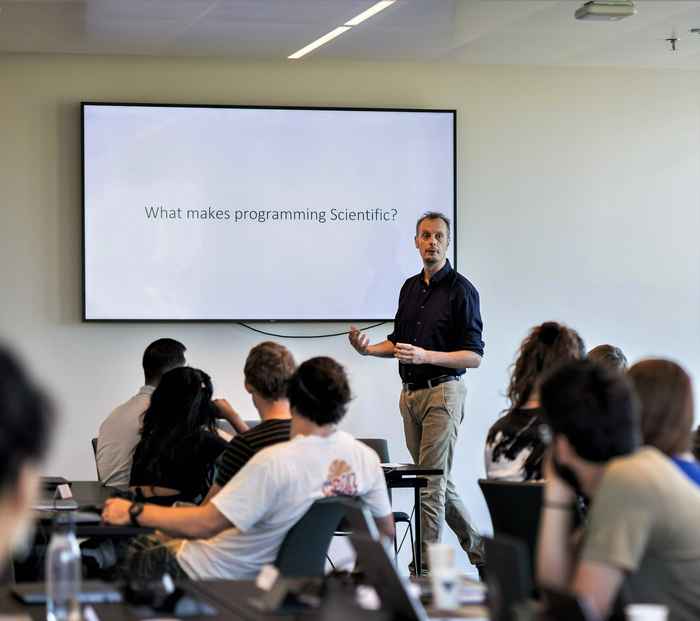
The course starts with a kick-off which will take place on our UvA Science Park campus. The goal is to get started with the course, get an overview of the topics that will be discussed and to meet fellow participants.
Kick-off Scientific Programming in Python II:
• Thursday 8 October 2026, 14:00–17:00
• Tuesday 2 March 2027, 14:00–17:00
Exam and certificate
Every module has an assignment which needs to be completed successfully to pass the course. If your assignment does not get a passing grade you will always be able to revise and resubmit the assignment. The courses conclude with a final exam which takes place at the Science Park campus. There are two exam opportunities, the final exam and a final resit (about two months later). In the meantime, you can still join the tutorials to get assistance.
After completing the modules successfully and passing the final exam you will receive a certificate from the University of Amsterdam which states you have succesfully completed the course.
Get a microcredential for the course!
As of September 2024, both Scientific Programming in Python I and II are part of the national pilot Microcredentials which means you can obtain a digital certificate in the form of a microcredential after you successfully completed one of these courses. This recognized credential gives value to individual education units, by guaranteeing the quality of the course, and therefore allows professionals to demonstrate acquired knowledge and skills to (future) employers or other educational institutions. More info information about microcredentials can be found here.
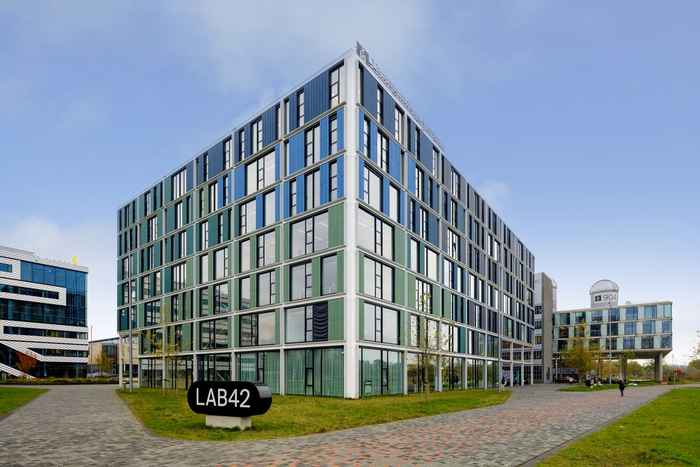
Both the kick-off and tutorials take place at Amsterdam Science Park in LAB42, an international hub for knowledge and talent development in digital innovation and AI. LAB42 is a vibrant space where AI researchers, computer scientists, students, and entrepreneurs come together to explore and advance the possibilities of artificial intelligence.
Contact
Do you have questions about this course? Please contact our professional education team:
E: professionaleducation-ivi@uva.nl