Decolonial Philosophies of Body Mind Soul
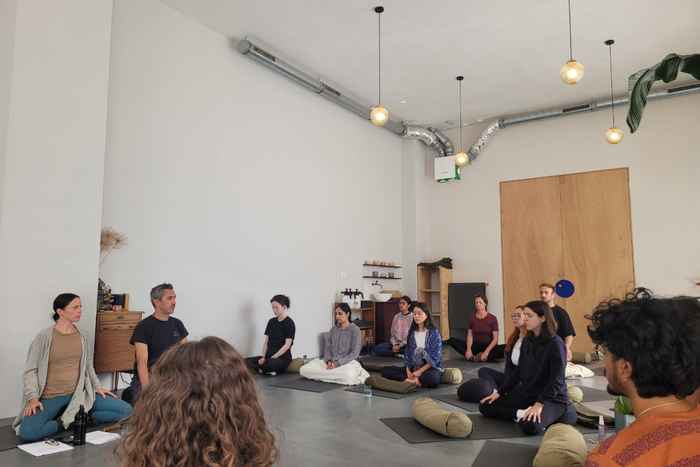
In this interdisciplinary course, you will investigate the Western divide between mind, body, and soul. You will also explore other ways of thinking through philosophy, decolonial theory, and embodied practice. Alongside readings, discussions, and writing exercises, you will also participate in qigong and movement workshops, encouraging a deeper multidimensional engagement with bodymindsoul connections and theoretical insight.
-
Programme at a glance
Mode of instruction: On-campus (3 weeks) Academic dates: Sunday 19 July - Thursday 6 August 2026 Housing dates: Friday 17 July - Friday 7 August 2026 Academic fees: Student fee:
€1750. Read more about what is included in the fees.
Professional fee:
€2000. Read more about what is included in the fees.
Housing fees: €900 for a private room and private facilities. Housing is optional. Read more about university-organised accomodation.
Credits: 6 European Credits. Read more about credits and credit transfer. Early admissions deadline: Sunday 1 February 2026
Students who require a Schengen Visa to study in the Netherlands are strongly advised to apply before the early deadline to ensure there is enough time to secure a visa appointment before the programme begins.
Regular admissions deadline: Monday 6 April 2026 Who is this programme for? Level: Advanced Bachelor and Masters students and working professionals
Background: Students should have an affinity for the close reading of dense philosophical, theoretical, and poetic texts. Fully understanding the material is not expected, but steady, committed reading and engagement with it is.
No prior experience is required for the bodywork workshops, and students of all experience levels are welcome.
-
Programme description
In this three-week programme, we examine how the Western ‘Enlightenment’ philosophical tradition has separated the mind from the body, elevating the mind while assigning the body a subservient, negligible, or dangerous role. We investigate the implications of this separation and embark on an exploration of multidimensional modes of potentially re-entangling body, mind, and soul through theory, bodywork, film, writing, discussion, reflection, and artistic expression.
First, under the guidance of course coordinator Maryam Babur, we briefly situate ourselves in the Cartesian mind-body divide, then move to decolonial critiques of time and space through thinkers such as Karen Barad and Walter D. Mignolo. We then turn to theories of lived experience, transformation, and the “unseen,” drawing on writers including bell hooks, Frantz Fanon, Édouard Glissant, María Lugones, and Gloria Anzaldúa. Parallel to this theoretical work, students will participate in qigong sessions focused on breathwork and body awareness, followed by movement-based research with Raoni/Muzho Saleh and Elioa Steffen.
All the while, we ask ourselves: how do we, or did we, or have we, define(d), entangle(d), or separate(d) bodymindsoul, individually and collectively; and how would we like to (re)define the entanglement or separation of bodymind/soul, individually and collectively? Must our choices in this be permanent, unmoving, and timeless? How would we like to position ourselves in space/time? What are the epistemological, ethical, metaphysical, psycho/socio/political, and lived consequences of our choices and desires? At what point do we congratulate ourselves for doing well, or are we (dis)satisfied, and why? And what happens if my choices differ from yours, and from those around us? How are we to live with one another when we position ourselves differently regarding our bodymindsouls?
-
Additional clarification
Students should note that a no-laptop policy is in place for this course and that handwritten exercises will play a role throughout.
Please also note that trigger warnings are in place for this course. Readings, film screenings, the sharing of lived experiences, and bodywork sessions may evoke vulnerability or trigger forms of dysregulation. All participants and instructors are expected to work to create a safe and brave environment, holding space for difficult moments and working through them collectively.
-
Academic director
Maryam Babur is a philosopher; she is a lecturer at Psychology, Politics, Law and Economics (PPLE, University of Amsterdam) and the School for New Dance Development (SNDO, Academy of Theatre and Dance, Amsterdam University of the Arts). In addition to teaching philosophy, and interdisciplinary theory, she has overseen multiple curriculum developments, and continues to research a range of themes including philosophy, spirituality, decoloniality, and anti-fascist and anti-racist pedagogy.
Maryam holds an Hon. B.Sc. with a double major in Biochemistry and Philosophy, as well as a Level 1 Writing Certificate from the University of Western Ontario. She completed a Research M.A. in Philosophy, cum laude, at the University of Amsterdam. Beyond academia, she has pursued courses in carpentry and camera journalism and actively maintains broad interests in art, film, architecture, activism, fiction, chemistry, alternative medicine, travel, hockey, and kung fu.
- Explore our community

- Mode
- Short-term
- Credits
- 6 ECTS, 3 weeks
- Language of instruction
- English
- Starts in
- July