Placemaking: from Practice to Impact
This three-week program explores placemaking—the philosophy and practice of enhancing urban spaces by involving their users. We’ll look at how it inspires place-led development, multiple value creation, entrepreneurial placemaking, and tactical urbanism—all aimed at making cities more human-centered with a higher quality of life.
-
Programme at a glance
Mode of instruction: On-campus (3 weeks) Academic dates: Thursday 25 June - Wednesday 15 July 2026 Housing dates: Wednesday 24 June - Thursday 16 July 2026 Academic fees: Student fee:
€1750. Read more about what is included in the fees.
Professional fee:
€2000. Read more about what is included in the fees.
Housing fees: €900 Private Private at Maassluisstraat.
Housing is optional. Read more about university-organised accomodation
Credits: 6 European Credits. Read more about credits and credit transfer. Early admission deadline: Sunday 1 February 2026
Students who require a Schengen Visa to study in the Netherlands are strongly advised to apply before the early deadline to ensure there is enough time to secure a visa appointment before the programme begins.
Regular admission deadline: Sunday, 15 March 2026 Who is this programme for? Level: Bachelors, Masters students and working professionals.
Background: Applicants should have an interest in urban studies, human geography, sociology and/or policy making. Working professionals with relevant experience in the above topics who wish to expand their knowledge in this field are also welcome to apply.
-
Programme description
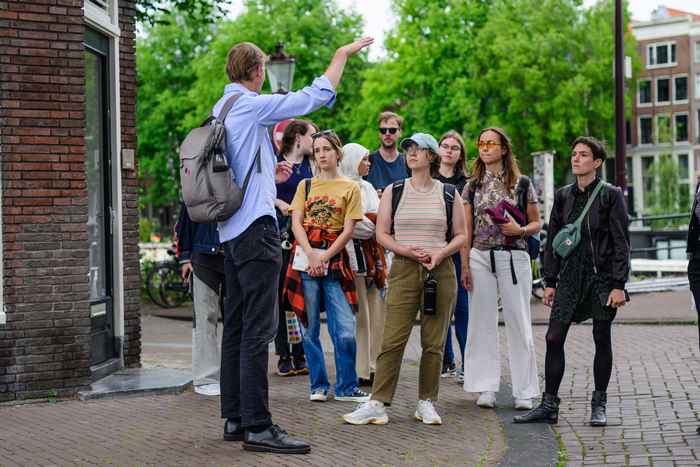
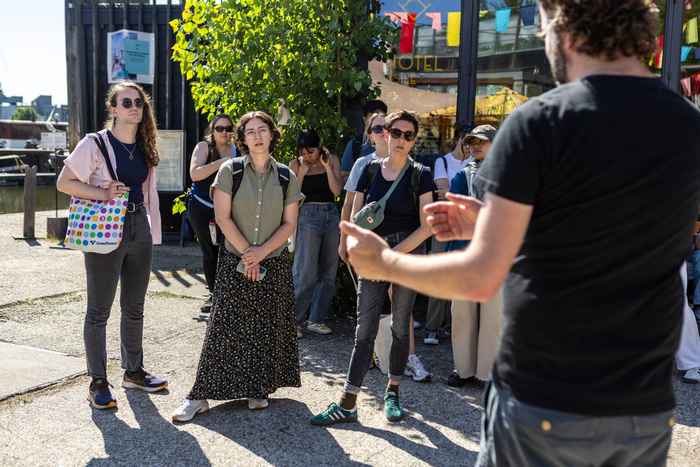
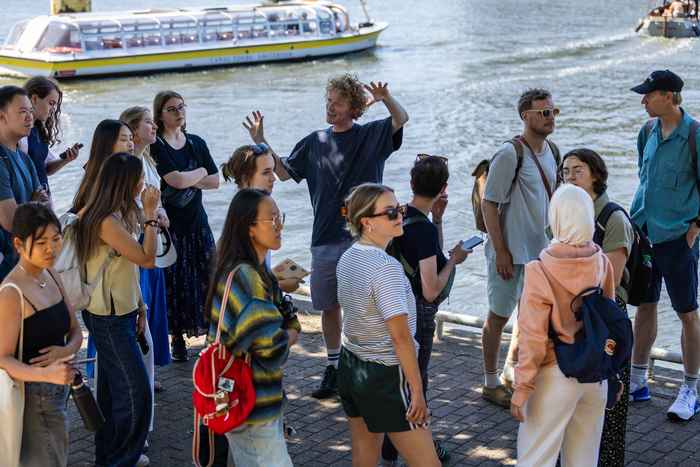
We will dive into the many local placemaking initiatives happening in transformation areas in Amsterdam. These are initiatives where residents, housing associations, governments and businesses work together. By learning from these real world examples, as well as through our own practice, we will explore key methodologies, theories, best practices and context sensitive ways to make an impact. In addition to tactical place based interventions, we will also explore the potential to reshape cities by (re)designing some of their foundational elements, specifically the rules and regulations that govern public spaces. This involves approaching public space as an expression of an “algorithm”, a set of rules and regulations in a city that collectively determine the spatial context and, in turn, the way we use urban space. Can we change the city by changing its algorithm?
Throughout the programme, we will draw on both local and international placemaking examples, and continually relate methods of practice to initiatives for impact. We will consider the various strategies through which we might contribute to improving the public realm, relating your own home city or village to cases in Amsterdam, or vice versa, across scales, from a single building, a pavement, or a street to whole neighbourhoods and beyond. With your student team, you will gradually develop a small scale intervention and test whether the proposed solutions lead to improvements for its users.
Through this Placemaking programme, you will be equipped to contribute directly to any place you choose to commit to, developing strategies and soft skills that matter and helping to realise change. Let’s go!
-
Academic directors
Bio Jesse Jop Jörg from We The City
We The City was founded in 2012 by Jesse Jörg and consists of an ever changing team of creatives, designers and producers who work at the intersection of concept development and urbanism. Our strength is based on creativity, the ability to ‘read’ the city and our collaborative mindset.
We The City proudly initiated BenchesCollective (now buurtbankjes), a grassrooted project that encouraged thousands of people from all around the world to turn their sidewalk into a little café for a day. We also initiated a now international rooftop festival encouraging people to have a better understanding of the potential of the vastly underused rooftop landscape. A recent project commissioned by RAUM is the Pop-Up Parking Service in which we encourage people to park something completely different than a car, challenging the fact that so much of our valuable public space is only being used for parking. The Pop-Up Parking Service is part of the podcast series we recently launched called Algorithm of the City. The podcast is an important inspiration for the Summerschool.
We The City believes in creating ripple effects, turning anonymous spaces into vibrant places. We operate with our ears and eyes wide open, constantly thinking of ways to change the city for the better. We The People. We The City.
Bio Joop de Boer en Jeroen Beekmans from Pop-Up City
Pop-Up City (PUC) is a creative agency based in Amsterdam, specializing in urban transformation and placemaking. Founded in 2007 by Jeroen Beekmans and Joop de Boer, PUC operates at the nexus of concept development, tactical urbanism, and strategic communication.
PUC collaborates on diverse urban projects across the Netherlands and internationally. Notable recent projects include the creation of the temporary Rhônepark in Amsterdam, a strategic placemaking initiative in Amsterdam SouthEast (Amstel III), and the publication of The City Changers Cookbook (2024).
Through its widely read international platform and the acclaimed book Pop-Up City: City-Making in a Fluid World (2014), PUC has established itself as a trendsetting voice in reimagining urban living for a dynamic and ever-changing world.
Guido Knibbe, Msc has led the Placemaking Summer School programme for three years, as well as teaching in the UvA's Placemaking undergrad programme. He is also co-developer of the Transition Makers Toolbox, an open-source online platform for learning materials based on the Inner Development Goals. Guido has a background in Sustainability studies and Cultural Anthropology, which he applies to the groundwork of societal transitions. As a board member and project lead for Amsterdam-based Foundation Wij Zijn De Re/Generatie, Guido works on the intersection of placemaking, community building and ecological regeneration.
-
Explore our community
Want to get to know more about studying in Amsterdam, and what the urban fabric of sensescapes is like? Follow us on social media and join our summer community. Get a feel for our summer school vibe and our academic and social community, and learn about studying with us through the eyes of past summer school students.
Interested in hearing more about placemaking as a methodology and ongoing placemaking projects in Amsterdam? Listen to some of our placemaking experts in this episode of our podcast, Mokum.
- Mode
- Short-term
- Credits
- 6 ECTS, 3 weeks
- Language of instruction
- English
- Starts in
- June