Organizational Ethics
Many of our biggest global challenges originate at least in part from unethical behavior and misconduct in organizations. Just consider the subprime loan sales by banks that caused the 2008 financial crisis, the sexual harassment as documented in the #MeToo scandals in public and private organizations that have forever scarred the lives of victims, and the continuing industrial pollution that destroys our natural resources, threatens public health, and contributes to climate change. After such incidents, the conclusion is often similar: the organization (or sub-department) had developed a negative environment that came to sustain individual wrongdoing. Unfortunately, we still lack a scientific understanding of how organizations develop such negative environments and traits, and how this can be prevented from happening.
The overarching goal of the RPA project was to develop an integrated understanding of how the organizational environment allows regulators and regulated organizations to detect risks of negative organizational dynamics before these lead to harmful misconduct and how misconduct spreads and can be remedied once it occurs. As such, Organizational Ethics main aims were to:
- Systematically understand what organizational traits are at play in cases where organizations structurally engage in damaging misconduct, and how such traits develop and shape structural damaging misconduct in different organizational settings and different points in time;
- Conduct scoping reviews, case-studies, time-lagged field studies and experiments to analyze patterns of negative environments and traits in organizations, and develop a unique, interdisciplinary language and method of study to address unethical organizational traits.
Main projects
Mapping of existing knowledge about organizational traits and misconduct
With the literature searches, the research first conceptualized what exactly should be studied to assess and diagnose organizational traits. Then it collected insights from across the social and organizational sciences to identify indicators for any negative traits, and collected and assessed existing studies about ethical, unethical, and negative organizational environments and cultures. This has resulted in the development of the Cambridge Handbook of Organisational Culture and Misconduct – which takes stock of current knowledge, theories, and approaches across twenty nine chapters written by experts in the field – as well as four scientific reviews.
A first scoping review of the literature focused on methodologies employed to study social dynamics of unethical behavior at work. Based on 487 relevant articles, it found several misalignments between theoretical frameworks and subsequent operationalizations of key constructs. A second review examined 303 of these studies in more detail to trace the social processes that are triggered after unethical behavior, brought these ideas together in a theoretical framework, and illuminated which moderators could stimulate or prevent toxic reactions. A third review zoomed in on organizational culture. Conceptualizing the construct as multi-dimensional, collectively shared and socially transmitted, it assessed the extent to which existing survey measurements of key organizational culture constructs, such as ethical culture and safety culture, capture those features, and found that there is room for theoretical and methodological improvement on this front. A fourth review then examined the empirical outcomes associated with these constructs, and found that the behaviors explained fall short of the deviant, intentional and harmful conduct of the heart of many organizational scandals. Finally, a fifth scoping review is using a specifically disciplinary approach to identify work and raise the issue of misconduct in the field of organizational anthropology.
Case studies
Following and inspired by the literature reviews, the project conducted case studies of organizations that have structurally engaged in damaging misconduct, to assess what elements in their organization came to sustain and promote such misconduct. This has resulted in three books. First is a collection of case studies by leading investigative journalists and academics covering major harm in public and private organizations – such as in Boeing, Chernobyl, and the catholic church – including an introduction that draws out six overarching lessons. Second is a popular science book that disseminates comparative lessons across 30 case studies to a broader general and practice audience. The final work concerns a doctoral dissertation, in which in-depth case studies on police misconduct in the Oakland and New York Police Departments are examined. As part of the RPA, students in the BA-course Anthropology of Organizations undertook 12 case studies on various organizations, and six students in the MA Applied Anthopology wrote their theses based on original case research.
Group interaction studies and controlled experiments
In a large-scale experiment, the directionality of relationships was examined. Experimental methods provide opportunities to intervene in and shape social interactions by means of specific manipulations and validated training programs. An example of the output of this sub-project is a study of ethical decision-making in 97 groups of business students (336 participants), which were asked to collectively resolve an ethical dilemma in a startup company. It was found that the timing, framing, and type of arguments (i.e., business-framed or ethics-framed) can influence groups toward more or less ethical decisions. Currently, these data are used to develop additional studies that can help to explain the social dynamics of how toxic culture develops and what is needed to prevent and curtail it.
Normative, legal, and regulatory analyses
Drawing on the case studies, field studies and experiments, the project assessed how the findings are and should be incorporated into organizational and regulatory rules, with a focus on the banking sector. This has resulted in two book chapters. The first demonstrates what happens to behaviour and culture when they become explicit objects of supervision by central banks. Following the global financial crisis, the Dutch Central Bank (DNB) emerged as a pioneer in developing a dedicated methodology for the supervision of behaviour and culture. The chapter traces the evolution of DNB’s behavioural supervision from its emergence in the aftermath of the financial crisis to its gradual incorporation into European banking supervision. It demonstrates how the translation of behavioural and cultural concerns into prudential supervision narrowed the range of problems and solutions that could be recognised within supervisory practice.
The second chapter builds the case for going beyond the limited forms of stakeholder engagement currently required of banks in relation to their decisions about where to allocate credit. Banks occupy a distinctive position in modern economies: their lending decisions influence which businesses grow, which technologies develop and, ultimately, which forms of economic and social development become possible. This position is not simply a result of market forces; it is also created and sustained by law. The chapter therefore asks whether depositors or those affected by specific corporate activities financed by banks should have more than a right to be informed or consulted about these decisions, and whether they should instead have some formal authority to shape them.
Scope & Theoretic Background
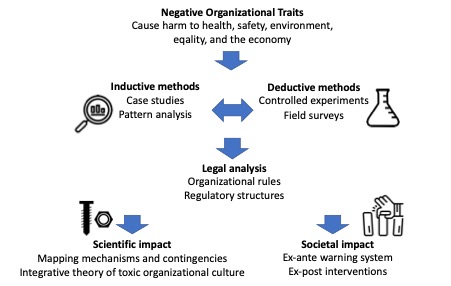
Organizational Ethics sought to make a major scientific breakthrough in developing a scientific agenda for how we think about and address organizational ethics. It developed a new social dynamic and pro-active approach to understanding and mitigating unethical organizational conduct. The project incorporated the full empirical cycle, starting with a grounded inductive method that systematically studies patterns and mechanisms of unethical behavior from existing cases. This approach was combined with a deductive method that analyzed the group dynamic processes in unethical organizational behavior and tested ways to influence these in laboratory and field settings. In doing so, it developed and stimulated a multidisciplinary series of studies to understand the social interactions in organizations that give rise to unethical behavior, tracking the different mechanisms that are at play over time. Finally, through normative and legal analysis, it grounded the empirical projects in the relevant legal and normative contexts. This allows drawing normative and ethical implications from the findings, and translate these back into the legal and regulatory institutions.
Due to the multi-disciplinary nature of our team, this project drew on empirical insights and theories from a wide variety of social and behavioral sciences. Furthermore, organizations from both the public and private sector were included in the case studies, making the practical implications resulting from the project applicable to a wide range of different organizations.
Societal relevance
Obtaining insights into the development of unethical, negative organizational traits can help to not only stop the development of such traits and environments, but also stimulate the creation of ethical, sustainable organizational environments. The knowledge gathered from the project can be used to develop an innovative scientifically grounded diagnosis to assess risk of unethical behavior at the earliest moment when it has not yet become deeply embedded in an organization, which can be used by regulators and regulated organizations alike.
Academic relevance
Organizational Ethics sought to integrate research strengths from across different disciplines to create a scientific breakthrough in our understanding of structural unethical behavior in organizations. It stimulated and will stimulate research projects that combine a unique multi-disciplinary approach to understanding the social dynamics of negative organizational traits, and that develop scientific insights into their diagnosis and treatment.
Fields tied in with the project include business ethics, behavioral ethics, behavioral economics, normative ethics, social psychology, organizational psychology, management, communication science, anthropology, organizational criminology, and private and regulatory law.
Contact
Do you have questions about the projects or researchers of the team Organizational Ethics? Here you'll find out how to get in touch.
To contact the team of Organizational Ethics please send an email to the Professor Law & Society Benjamin Van Rooij.