Assessment guidelines
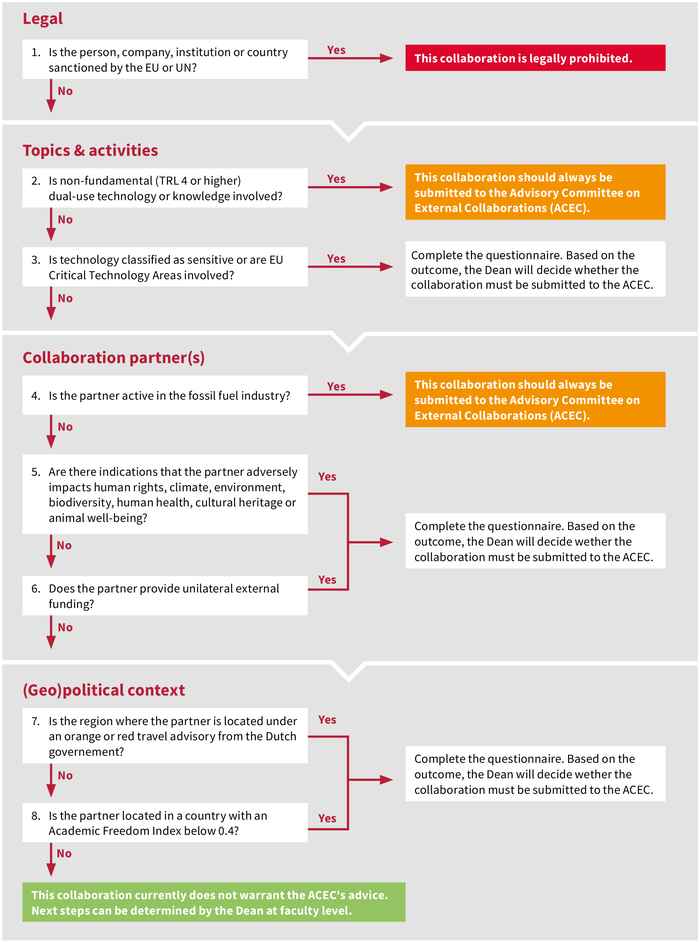
The UvA aims to collaborate with partners on projects that are based on shared values. Our teaching and research must ultimately contribute to human well-being and to strengthening society.
View the assessment tools on the staff website (with login)
Which collaborations to assess?
It is not necessary to assess individual collaborations, e.g. a joint paper, a presentation at a conference, a guest lecture, or a student internship.
It may be necessary for the UvA’s Advisory Committee on Collaboration with Third Parties to advise on formal collaborations. Any project that is only able to start when approved by the UvA is a formal collaboration. For example, student exchanges, research in a consortium or with companies, non-profit organisations or governments, data-sharing agreements and the unilateral funding of UvA activities.
On what does the assessment of a collaboration focus?
Assessments focus particularly on the following questions:
- Is there any risk that a project will contribute to an armed conflict or human rights violations?
- Is there any risk to knowledge security or that knowledge will be misused for undesirable military or terrorist purposes?
- Is there any risk that a project will contribute to irreversible damage to the environment, biodiversity, human health, cultural heritage or animal welfare?
How does the assessment process work?
The UvA always asks employees to assess whether a collaboration is a good match with the university’s core values as soon as possible. The committee may advise on current projects if risks increase as a result of geopolitical developments or changes in the profile of the collaboration partner.
Steps and division of roles
- When assessing new and existing projects, employees use a tool that guides them through a comprehensive step-by-step plan, a questionnaire and a set of guidelines with an action plan. If necessary, employees discuss the outcomes with their directors, faculty contact persons or a dean.
- The Executive Board or a dean may decide to submit projects to the experts in the Advisory Committee on Collaboration with Third Parties. The committee may ask Executive Board or dean in question for additional information.
- The committee advises the Executive Board or dean; it is not authorised to make a decision about the project.
- After receiving the committee's advice, the dean or Executive Board will make a decision on the project in question.
- The step-by-step plan above is complementary to the faculty or department’s procedures and agreements.